


Two small visitors to my garden reminded me of something I had forgotten. The beauty of desert gardens is in their simplicity.
The first little visitor, the middle of three boys, with sandy blonde hair, freckles, a wide smile: “I see a cactus squatting on the ground.”
Cactus are a delight; odd and different right down to how they photosynthesize. The days are too hot to waste precious water through transpiration, so they keep their stomata (tiny pores similar to those on your nose) closed during the day. At night, when the air is cooler, they open up to absorb carbon dioxide, which they store until the sunlight returns and they can convert it all into usable energy. In this way, they time-shift, just like we do. We share more with cactus than roses, even if we have taken to preferring the latter in our gardens.
The second little visitor, the youngest of two brothers, his voice as clear as a wind chime on a warm day, his vowels long and continental: “I see a palm tree standing against the sky.”
Palm trees are iconic desert plants. I say this despite the controversy they’ve garnered in some circles. They do well here, and humans have been growing them in the desert for a long time. The palm tree is to Vegas as the creosote is to the eastern Mojave. Neither belongs here, they are both imports. Vegas itself is a chimera; still, it persists.
Desert garden grammar
My two little garden visitors reminded me that desert landscapes of all kinds are legible in ways that the great subtropical forests of the Northwest are not, or even the oft-copied prairies of the Midwest. The desert garden’s grammar is more approachable, even if its materials (spiky, hot, austere, dry) are not.
Children instantly get the desert garden. Cactus, palm trees, sun, and sky. Adults find it so hard.
Part of the reason is that we make gardening in the Mojave difficult by bringing all sorts of prior assumptions of what a garden should look like. When we do that, we make an already difficult task almost impossible. Not just in terms of the physical demands of desert gardening, but psychologically as well.
The desert has asked me to change a lot of my expectations around what counts as beautiful; I appreciate my two little garden visitors for reminding me just how cool my garden is.
Of course, desert gardens are more than cactus and palm trees. They are shrubs, ground covers, flowering perennials, and a dizzying array of ephemeral annuals. Here are two non-cactus plants I’m particularly excited about.
Two white flowers
I sowed Datura wrightii (sacred datura) seeds earlier this spring in pots. Last fall, I collected them from the ground around the ranch house at Spring Mountain Ranch State Park. Most did not germinate, but two did. I got one in the ground two weeks ago, and it has already quadrupled in size. The second I planted in a newly bare space, after a strong wind took half of a Tecoma x alata ‘Orange Jubilee’ with it.
Datura is perennial and comes from the same family as potatoes, eggplant, and tomatoes (Solanaceae). It's a vigorous plant that requires little in the way of effort. A botanist friend told me they thrive in Death Valley.
Growing up, my neighbor grew Datura along the fence that separated our front yards. I hated them. They smelled like rancid peanut butter, their leaves were weirdly gray, and the flowers never seemed to be open (they are a night bloomer, pollinated by hawk moths—my favorite garden visitor).
You come into the desert trying to change it, but eventually you accept that the desert changes you.
Another weedy-looking plant with beautiful flowers: Argemone polyanthemos (prickly poppy). I’ve sown seeds all about the garden, but none of them have come up. Maybe next year. Fortunately, they are blooming in Kyle Canyon, where I took this photo.
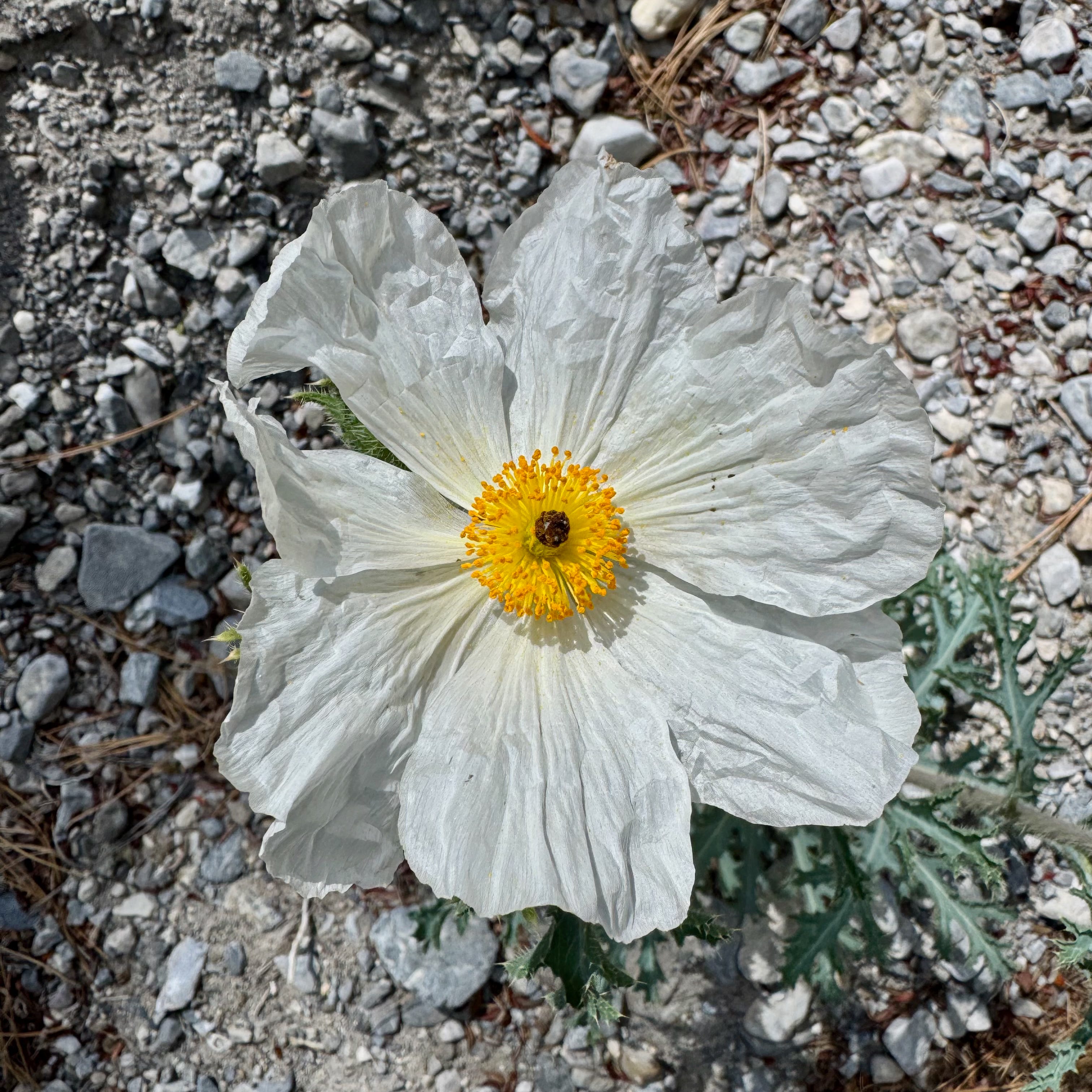
Their delicate white petals and dark yellow anthers grow from thistle-looking foliage. Like an egg, sunny side up, has sprouted from dry ground. Prickly poppies are annuals, so if I keep sowing seeds, some of them will eventually germinate and I’ll have a stand that returns every year. For now, I enjoy them up the canyon.
Hiking, my son and I came across a blooming datura plant in a rocky wash. He said, suspicious of the enormous white flowers, "That can't be native!" I had to laugh. It seems to defy what we think desert adapted plants should look like. But I think your comment about how we come to the desert wanting to change it and end up different ourselves is so apt and insightful.
Thank you, Isaac, I really enjoy all of your posts and always look forward to the next!