


Moominpapa has escaped the orphanage and gone into the forest. By a little brook, on the sandy edge of the water, he draws the house of his dreams. There are wide stairs, balconies, turrets. “Upstairs I made three small rooms and a closet for odds and ends,” he says. “Downstairs was only a single, large, magnificent drawing room.” He becomes so immersed in the drawing of his house that he projects himself into the already constructed place. “Come take a look at my new house!” he says to a hedgehog.
“I led the way, and while I walked, I began to have a nasty feeling crawling up my legs and into my stomach…Dear reader, as you must understand, I had entered so powerfully into the project that I had really thought that the house was finished!”
All of Tove Jansson’s wonderful Moomin characters are concerned with nature (are nature), and offer many lessons for the gardener. I have felt crawling up my legs the suspicion that what I see in the garden may not be shared with my visitors (or readers), that what appears to them is only a drawing in the sand, and perhaps a shabby one at that.
What exactly are gardeners looking at when they see a garden? How might this differ from the visitor who comes upon a pretty planting?
When I look at the garden, do I see it for what it is? Or for what it may become? Does one take preference over the other, or is it both at once so that what emerges is something altogether new, or different?
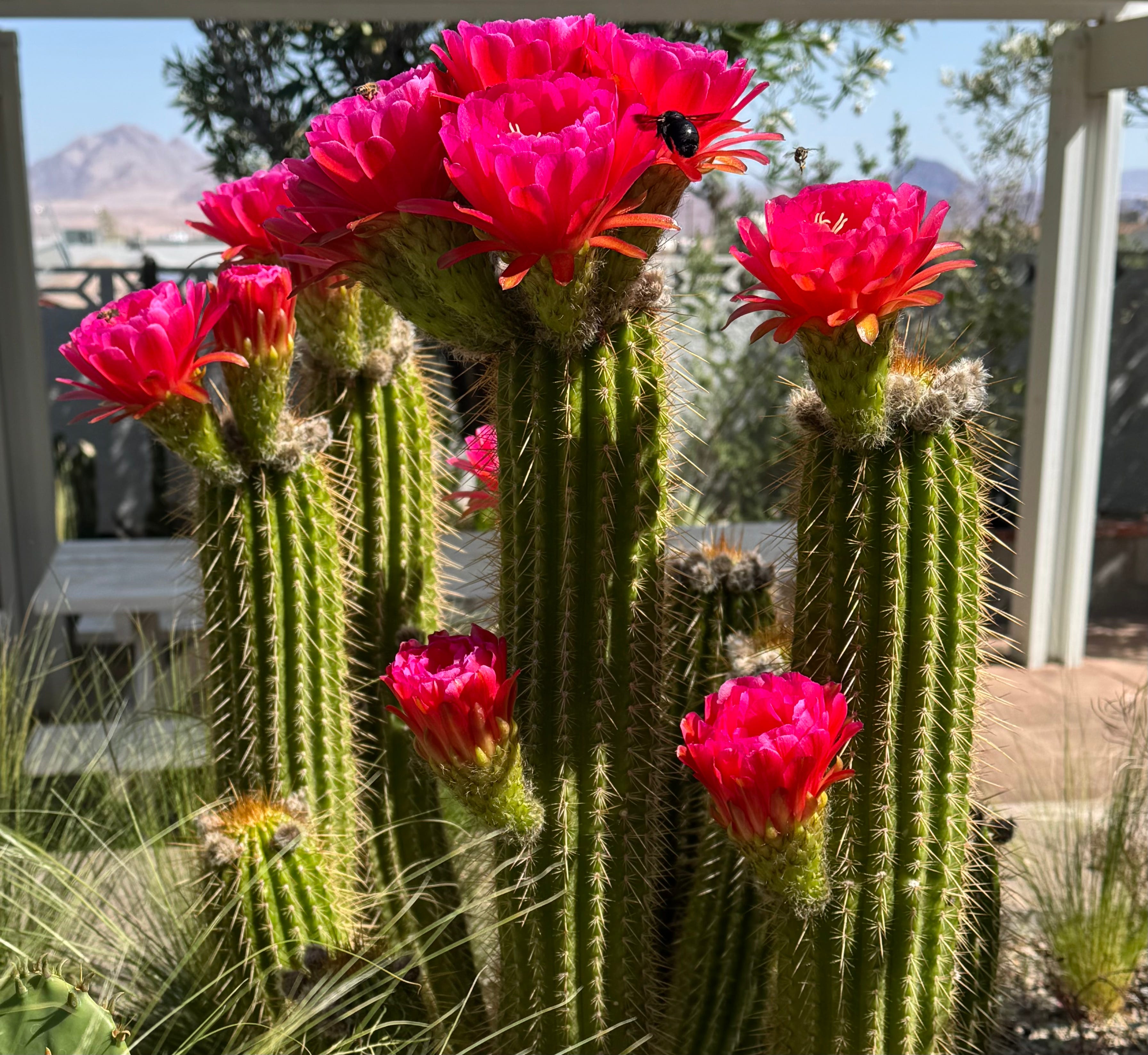
Spending time in a garden predisposes us to a particular way of seeing. My mind skips about. I see the torch cactus now. I see it in a few weeks when the nascent buds have swelled and bloomed. I see it years from now: old growth cascades over itself, and from the heart of the plant emerge new columns. They push aside the old, grow up and out, only to start this great enlargening again.
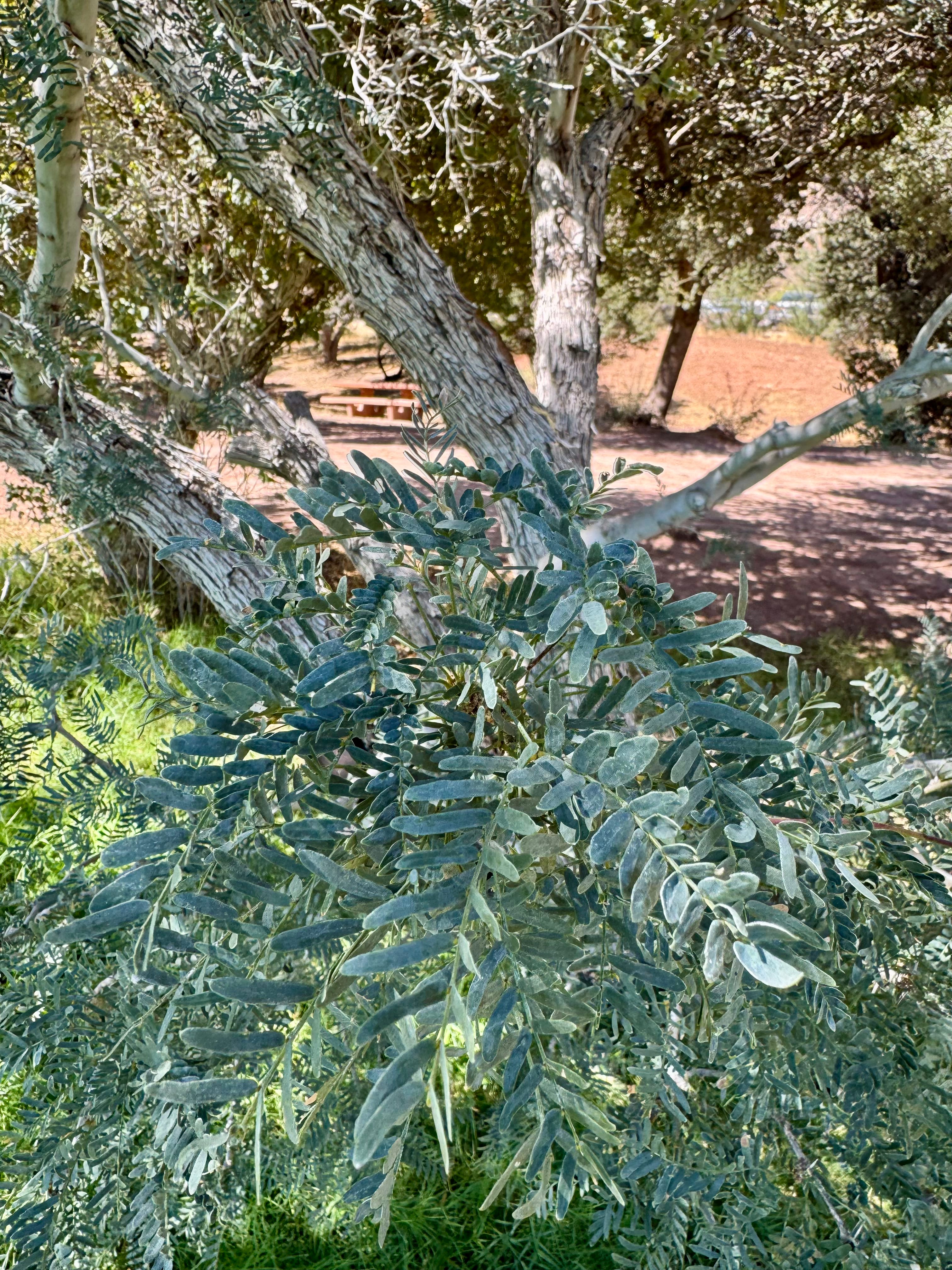
Or the saplings I’m growing. I collected the seeds from a strange mesquite at Spring Mountain Ranch. The leaflets were blue-gray, the bark a light gray—the very image of an ironwood, but certainly a mesquite. I’ve planted one in the garden. I see two small whips growing up from the ground; I see its awkward adolescence. I see the old gray-white bark unfurling into a magnificent tree. When I look at that sapling, what garden do I see? How far into the future might my perception take me? To a time when the wood is brittle, the lower branches self-pruned. A stately tree appears among the ruins of my house, barely surviving without supplemental water, the summers too hot to support almost any kind of life that I would recognize today.
I often draw new plantings by hand, though I confess I’ve been more carefree about my desert garden. I physically laid out the plants based on the image of the garden in my mind. They were hardly more than a sand drawing, a two-dimensional landscape, little lumps of green and blue overshadowed by the water wells I dug around them. Seventy-five percent of those plants remain; the others did not make my brutal watering regime, or because I did not understand exactly how they would handle light and shade as the planting grew in. Even then, when it was a two-dimensional nursery, I saw it looking something like it does today (surprised that a garden has appeared).
I suppose one could argue that the gardener is always restless in the garden, always swatting away the creepy crawlies of suspicion, unable to see the garden as it actually is, too caught up in how it will look after a rain, or in the spring, or in the fall, or fifteen years from now. But who is to say that *that* is not the garden?
Gardens are a bit like crystal balls; they reflect (and distort) the future. This way of seeing is unique to gardeners, to those who plan and plant, sow and cultivate. To see a meadow in a handful of seeds, mixed with sand and coir, broadcast across a vacant plot, is to understand what a garden is. Which means that to perceive a garden as it actually is may be impossible for the gardener. The gardener collapses different ways of perceiving into the single moment of viewing; the moment is all we have, and yet it is also the conditions for all we are likely to see.
Among crafts, the garden must be unique, at least in this sense. The work of art is viewed as completed (or abandoned), whereas the garden is never completed. When abandoned, it persists in some wilder way—I can perceive that, too, as I wander my yard’s narrow paths.
And so it is with Moominpapa. He is so caught up in the idea of his house that he is quite surprised, embarrassed even, to see that it is only markings in the sand. Gone are the balustrades, the intricate woodwork. Is it only a little sand, a little brook babbling, a friend peering over his shoulder, unable to see what Moominpapa sees.
The garden is probably the closest thing we will ever get to time travel; gardeners a bit like time travelers. We see what a garden may become. Becoming mixes with what is. What we create bounces along temporal and spatial lines. I do not imagine the grown mesquite; I can see it. The pleasure of gardening comes from this fact, to which the gardener is uniquely attuned.