


If one were to devise a spectrum for growing things, with wild places at one end (if such a thing even exists) and irrigated farming at the other, the garden would fall somewhere in the middle. It is a place that cannot exist without the gardener, but it is also more resilient than the farm plot. Gardeners have long learned from wild places. Perhaps it is time for farmers to learn from gardens.
But gardening in the United States has doubtless been influenced by farming, courtesy of the well-meaning extension campuses of the large land grant universities. Extensions may have been created to help small farmers, but, as Wendell Berry has argued, they turned into showrooms for agribusiness, sales funnels for heavy machinery and industrial fertilizers. When master gardener programs started to pop up around the country in the 1970s, those same extensions took the lessons they learned from farming and applied them to the garden, which is why extension programs tend to focus on productivity over organic gardening, aesthetic considerations, or even moral obligations. Blanket statements are rarely accurate. Today, many master gardener programs have transitioned to a more gentle application of farming technologies. Many people who work in extension programs are dedicated to organic principles, to principles of care rather than conquest.
I consider this history and my own training in a master gardener program as I contemplate the role of home gardens in the desert foodscape.
I am not very good at growing food on the edges of the Las Vegas valley. When I gardened in the rich ancient lake-bottom soils of Salt Lake City, I could grow just about anything with a little extra water and the well-timed application of compost, all accomplished during the traditional, more temperate gardening year. In the Mojave Desert, that ease has vanished, never existed.
But it was gardening for food that got me interested in gardening in the first place. I grew tomatoes in silent competition with my 10th-grade honors English teacher, who once bragged about eating tomatoes before Independence Day. I could get a tomato sooner, I thought, and subsequently babied a row of Early Girls in the down back of my parents’ property, covering them with five-gallon buckets in early spring, then manufacturing impromptu greenhouses out of plastic sheeting and chicken netting when the plants got too big for their high-density polyethylene enclosures. I got tomatoes very early that year when, finally following the advice of a long-time neighbor-gardener, I pulled back on the Miracle-Gro and watering, and the big fat fruits finally ripened.
In most of the country, tomato plants are a gateway drug to broader gardening. They certainly were for me. But they can be difficult to grow in the low desert; our two growing seasons are almost too short. Cherry tomatoes do well here, and I snack on tomatoes all spring, pulling them out at the end of May (or sooner) when daytime temperatures make it difficult for fruit to set.
I’ve adapted to growing different foods, and growing them during the appointed times (all winter long for some leafy annuals). I’ve learned to grow all sorts of plants for their aesthetic value, and, along the way, I’ve learned that many of these so-called ornamentals are also food plants. The difference, however, is who they feed.
Today, I primarily grow food for winged vertebrates and invertebrates, crawling insects, and the packrat who resists all my attempts at capture. While I may not directly contribute to our food web in the form of summer-grown beans and tomatoes and zucchini, I am still growing food.
Essential to this food work has been my slow introduction to the majesty of native shrubs. Native shrubs are among the best food sources for local wildlife. They are easy to grow, requiring neither soil amendments nor fertilizers, and only a little extra water when they are getting established (more if I want them to grow faster or look a little more polished year-round).
My introduction to native plants has been slow because container-grown plants are often hard to source, and because I am a poor germinator of seeds, though even these can be hard to find. As native plants appear more often in local nurseries, I’ve taken to trying them out in the garden. I’m exploring them just as slowly as I acquire them, learning how they flourish in my own garden. When a shrub does well, I find a few more of the same species (or cultivar, in some cases) and add them generously to the garden.
Here are three shrubs I recommend to desert gardeners. They are increasingly easy to find at a nursery, they add rugged beauty and a sense of place to the garden, and they support wildlife—birds and pollinators in particular. Many of these shrubs can be food for humans, too, assuming you get to the berries before the birds do.
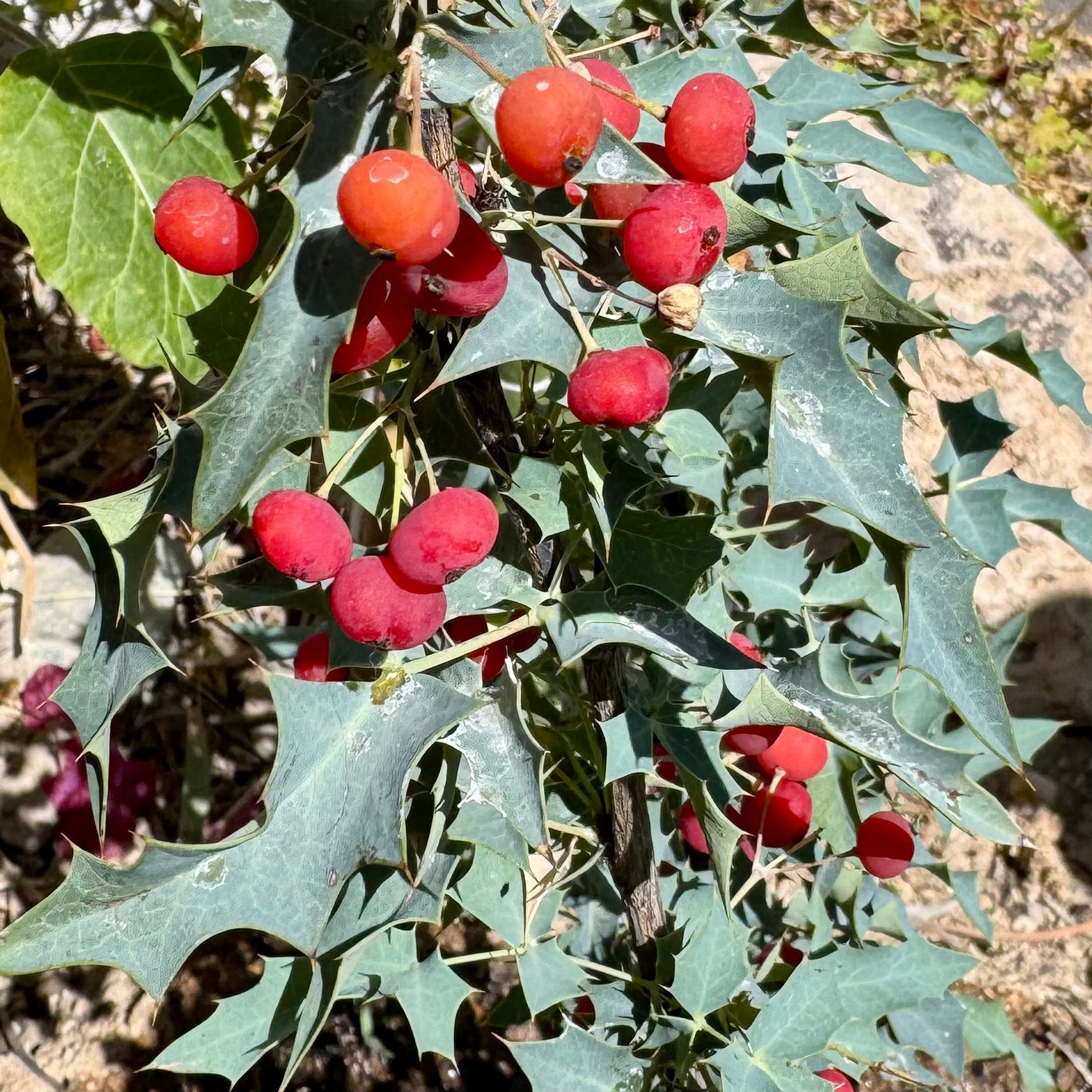
Berberis fremontii (Freemont barberry) — Blue, holly-like leaves, yellow flowers, and red-and-orange berries. The internet reports that, in small quantities, the berries can be eaten, though you’re unlikely to beat the birds. A day after the photo above was taken, all the berries were gone. Go birds! This plant is related to the very popular Creeping Oregon grape (Berberis repens, formerly Mahonia repens), which is commonly seen in high desert gardens.
Lyceum fremontii (Desert wolfberry) — Wolfberries are edible, and while I’m yet to harvest any, they are extraordinarily nutritious. It has been fast-growing in my garden, which means I’m probably overwatering it.
Salvia dorrii (Desert sage) — I was delighted to finally get my hands on this plant after multiple failed attempts to collect and germinate seeds from the wild. Its bluish-purple blossoms are a little less blue than desert chia, which, with its longer bloom season, would look pretty planted among drifts of desert sage—you can eat the chia seeds, and the butterflies and bees can enjoy the flowers of both. The leaves have that incredible sage scent that this formerly-Great Basin gardener can’t get enough of.
The Berberis sounds intriguing! I was familiar with Mahonia, which is a higher-water use plant. Where do you grow it in your garden?
A bit out of the way, getting mostly full sun, with a little protection from hot afternoon sun from a mature bougainvillea that grows along a wall near it. That whole side of the yard is starting to look a bit unwelcoming in terms of spines and thorns. 😈