


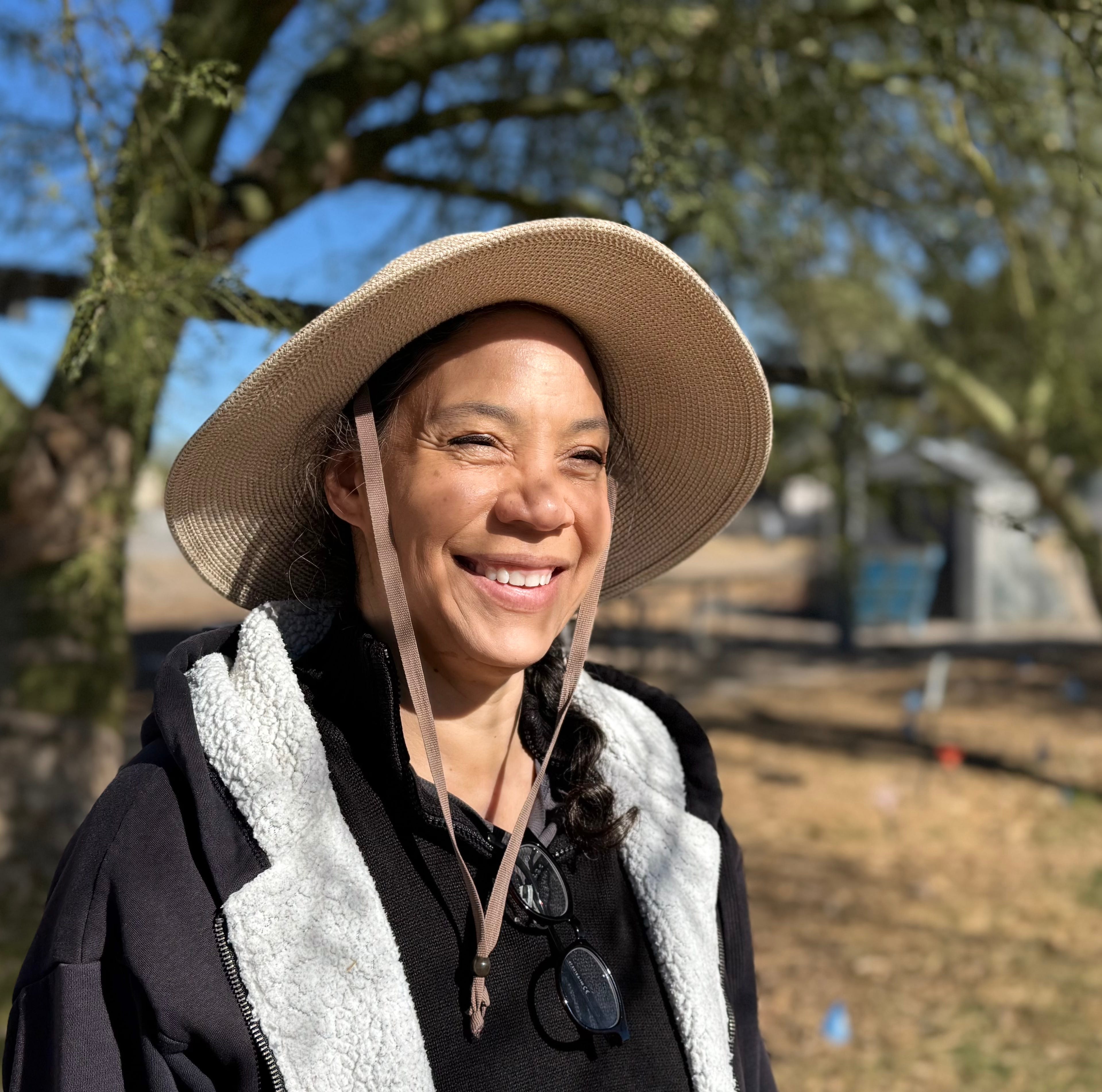
It has been an unusually warm winter in Las Vegas, but Michele Chambliss, founder and owner of Perennial Garden Consultants, was shivering. We sat under the slatted shade of a pergola about twenty feet from the three raised beds she cares for at the Provident Community Garden, where it finally felt a little like a Mojave winter.
Michele, one of Las Vegas’s few progressive garden designers, met with me so I could write about her for Mojave Gardener. But also because I wanted to meet her.
I have read her quarterly garden design newsletter since moving here, my mouth watering at her descriptions, my eyes fixed on the photos, as my heart ached for the kind of clear, simple, artful and flowering beauty that all of her designed gardens possess. But the path to those gardens did not run straight—and her education, from Las Vegas to New Orleans to the Bay Area and back home, offers a master class in gardening, even for one of the most arid places in North America.
I asked Michele if she preferred to sit in the sun, where it was warmer. She said she did and we walked over to her beds, both of us sitting, facing out, the sun warming our backs and the concrete pavers warming our undersides, and talked. The bed we faced held some of Michele’s favorite perennials: three kinds of penstemon (p. palmeri and p. parryi among them), a large blackfoot daisy (Melampodium leucanthum) that cascaded over the concrete walls of the bed, and half a dozen other plants that were huddled in their winter dormancy.
Michele possesses the quiet, introverted, and immovable mannerisms—as if she is part plant—of a great gardener. When she talks, she tends to hold her own hands, clearly uncomfortable with the attention she’s getting. But soon she forgets, looking out over the parched landscape and into the recesses of her memory.
She was born and raised in Las Vegas, growing up here in the 70s and 80s, back when the Valley was about a tenth of the size it is today.
“As kids we had two streets out there in the desert that we played on and there was nothing else around,” she said. “We called them front street and back street.”
My mom tells similar stories of growing up in the valley, a decade or so before Michele, back when it was fully desert. My mom rode ponies in what is now the shopping courts and subdivisions of Silverado Ranch. Michele also ran through scrub, creosote and beavertail cactus, where she started to notice the imported plants that were growing then across the manicured environs of the valley, mostly mulberry, fruiting olive, and oleander. They made up what she terms the 70s plant palette, and there are many neighborhoods that still bear signs of this gardening style.
So when Michele moved from Las Vegas to New Orleans, she was shocked by how lush and floral the landscape was, saturated in the deep, glossy greens of subtropical foliage. She began working for a landscaping company there, the beginning of her horticultural training. “I didn’t even know how to pronounce hydrangea,” she said, recalling her first job. “I’d never seen one!”
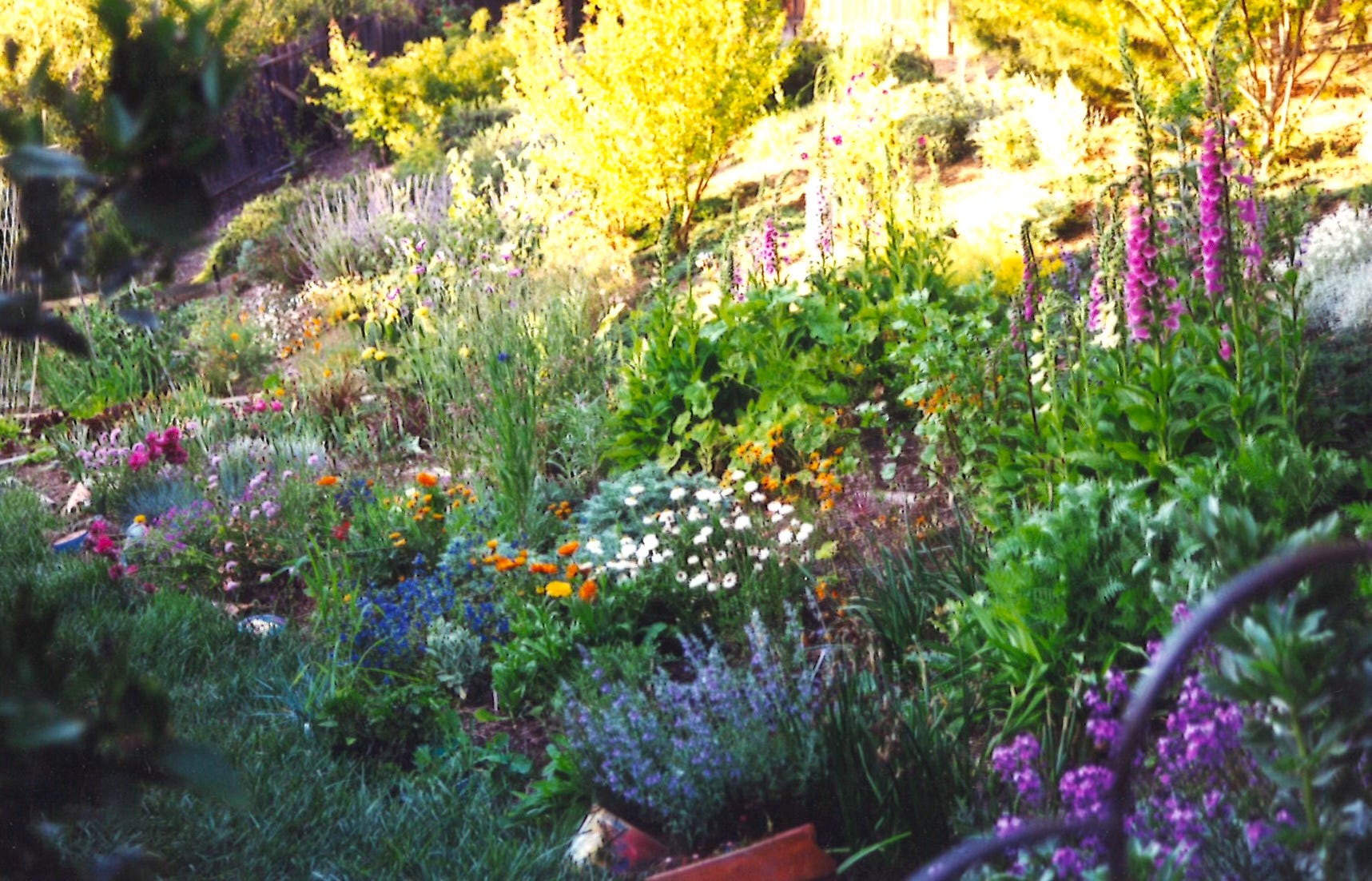
She took classes and jobs here and there, before moving to the Bay Area where she continued her education, enrolling in an ornamental horticulture program at Diablo Valley College in Pleasant Hill, and then interning for a landscape contractor in Pleasanton. It was there, outside of San Francisco, that she had her first in-the-ground garden—a hot, dry slope made of heavy, clay soil.
Michele held off gardening that slope for a whole year. She planted sunflowers, but that was it, instead taking her time to really understand her new place. “I watched it through the seasons,” she said. Until finally she made her first major contributions to the garden, which began by terracing the backyard and planting a large, weeping willow to stabilize the slope and to soak up all the extra water in the heavy soil.
“Everything starts with place,” she said, as our thoughts turned to Las Vegas and where she returned after her horticultural education in the Bay Area and New Orleans. “We don’t have as much wiggle room. Or grace,” she added.
“When I got back to Vegas it kind of killed my spirit,” she continued.
I felt her pain, even all these years later, when she told me that. I feel it, too. This is a hard and brutal and unforgiving climate. We get a paltry four inches of rain, our summers bake and our winters freeze—although, they freeze less often now than they used to.
Nevertheless, Michele continued to make gardens. I asked her what fed her spirit, and she told me it was the plants. And the community. And the people. Springs Preserve, in particular.
“Springs Preserve got me back into doing gardens. They showed me what’s possible. Visiting Springs Preserve got my spirit back,” she said. “Still to this day, I get inspired all over again.”
Springs Preserve, a public garden administered by Southern Nevada Water Authority, is the crown jewel of Las Vegas’s few public gardens. It feeds my spirit, too. I remember distinctly standing at the top of cactus alley last summer after leaving my corporate job. The future seemed suddenly so open.
Cactus alley is a long, formal series of beds overflowing with hundreds of species of cactus and desert succulents— barrels and columns, little pincushions and giant saguaros, paddles, agaves, and yuccas. I felt heat rise up from the crushed gravel path, dappled light fell across my neck and shoulders, and a still, small feeling rested there, in the crux of that moment, urging me to stay, to love, to live, and to garden in this hostile landscape.
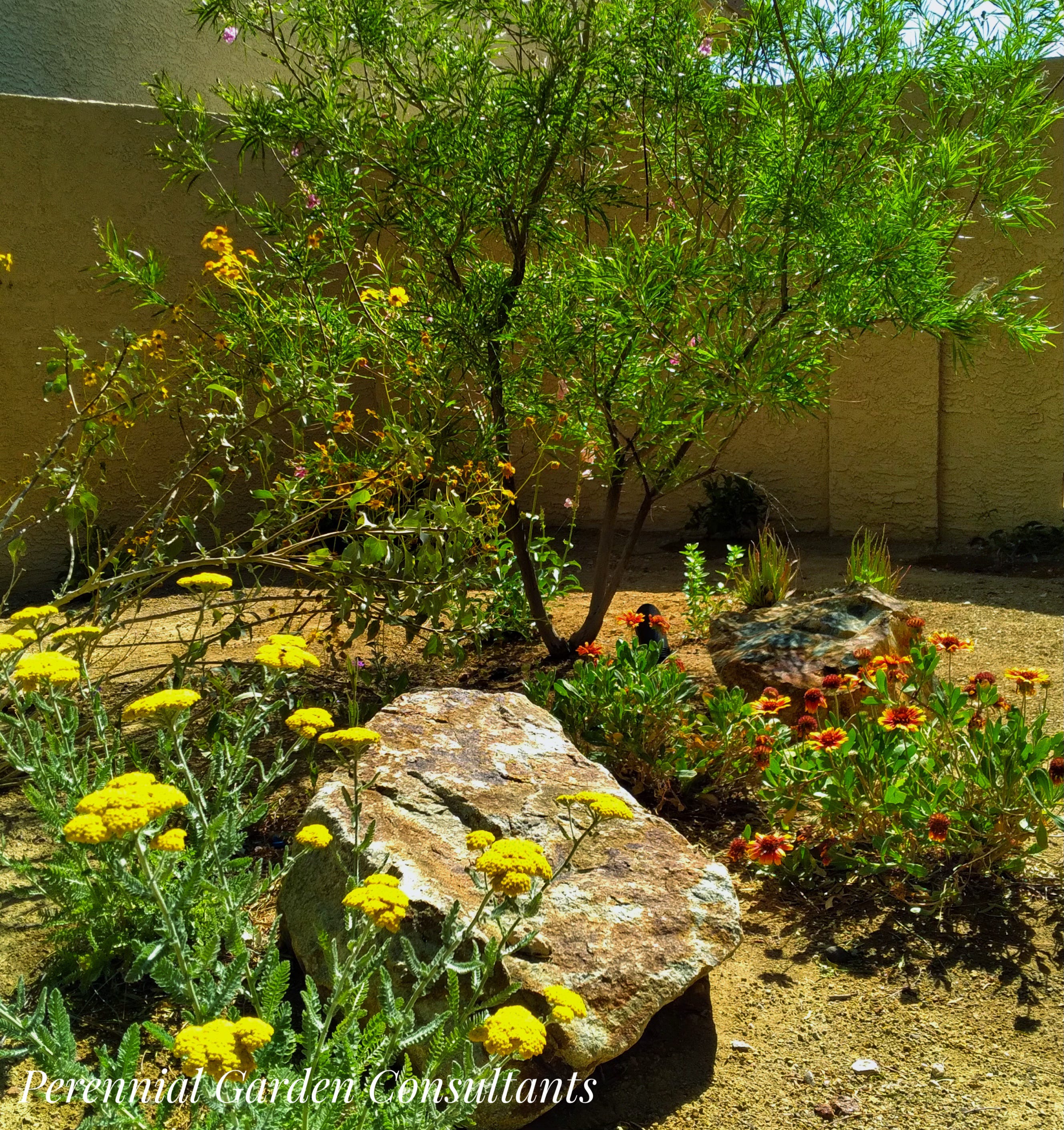
It’s true that our plant palate is very small here—but that means we have an opportunity to use all of it. Every last plant that can grow here ought to be tried here. That small palate also has the effect of freeing us from some of the constraints of design that gardeners in other places might experience.
“In other places you can afford to be a color snob,” Michele said, for example. Not so here—if something flowers, especially regularly or intensely, who cares if the color clashes once or twice a year with something planted nearby. The desert light’s intensity washes out many colors anyway.
But it isn’t easy to argue for plants in Las Vegas. We are a transient community, and people come from all over the world to live here, each bringing with them their idea of what a garden should be.
“Vegas has a reputation for being a fantasyland,” Michele said. “Why can’t I have a Hawaii in my backyard?” Or a New Orleans, or a Southern California, or a Seattle, or a Michigan. And the fact of USDA hardiness zones does not make it any easier. Gardeners from other climates see Zone 9 and think they will be able to grow almost anything. But it’s not enough. “Not even near the whole picture,” Michele said. Adding that New Orleans, her East Bay garden, and Las Vegas are all in Zone 9. Still, you can’t imagine more different places to garden.
For gardeners new to Las Vegas, the Sunset zones can be helpful for understanding the impact of heat and sun. But it also takes understanding that the desert is just different. “The desert is its own kind of beauty,” she said. “It takes time for people to adjust their eyes.”
Apart from the sun’s intensity, there is also the matter of rainfall. While we can supplement our gardens with water pulled from the Colorado River, it is a poor substitute for rainfall. “Rain is organic fertilizer,” Michele said. “It’s not just the moisture. It’s also the nutrients. It washes the dust off of stuff.”
Indeed, there is nothing more glorious than a desert garden after a rain storm, so lush and fragrant. If it looks like your garden has grown after a rain storm, it’s because it has, Michele said. Our gardens do most of their growing during those brief and blessed events.
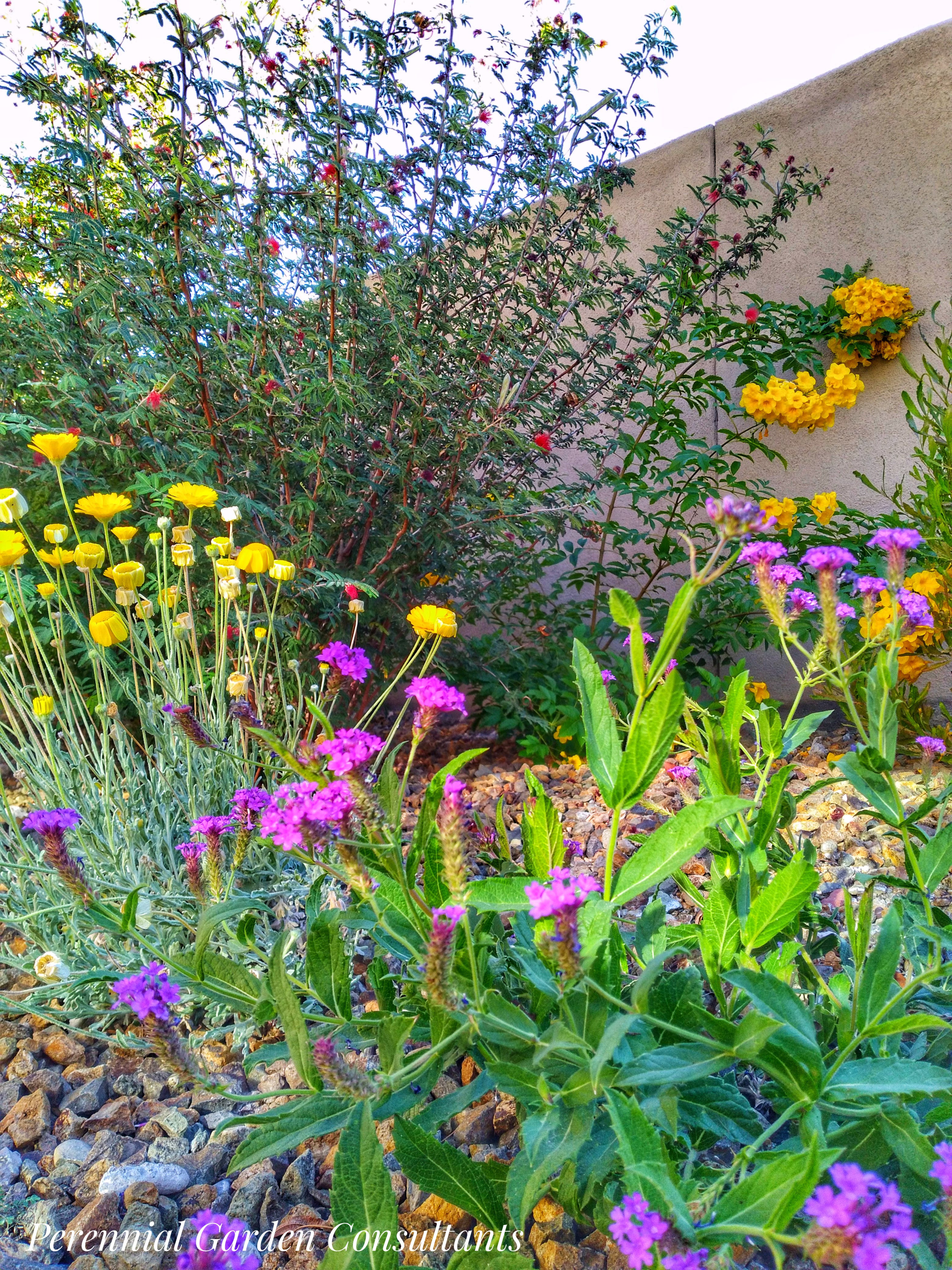
In all the heat, and rock, and dust of the eastern Mojave, Michele sees some quality that nourishes her, allows her to persist.
Being a garden designer in this town is not easy. People want their gardens to look like Southern California. Or they want hardly any garden at all: a great expanse of gravel punctuated with a few small, easy-to-manage plants. They want their shrubs sheared so that no messy flowers grow. In that environment, Michele is something of an evangelist. A much needed voice calling out from desert wilderness, asking us to consider our gardens a little differently.
Aside from being sites of beauty and places of refuge for people, Michele also designs gardens with nature in mind. “I love gardens that attract life,” she said. "We have an opportunity to give back with our gardens, no matter how big or small.”
Michele looked across the community garden as she talked about this debt—this thing we owe this land we call home—as if the plants and animals of some Edenic paradise were there, just beyond my visual field of perception, but that she could clearly see.
“Gardens are always changing. Sometimes we need to adjust for that. Losing a plant is an opportunity to try something new. That is part of the fun of gardening. Trying new things. Gardeners make the best gardens, not designers. The people who really know their space and live and love it,” she said.
Six of Michele’s (currently) favorite plants
Plant choices should always be place-driven, but here are six of Michele’s currently favorite plants. Give one, or all of them, a try in your garden this spring. For more specific advice, consider booking a consultation with Michele.
Desert marigold (Baileya multiradiata)
Parry’s penstemon (Penstemon parryi)
Brittlebush (Encelia farinosa)
Desert willow (Chilopsis linearis)
Creosote (Larrea tridentata)
Strawberry hedgehog cactus (Echinocereus engelmanii)
What a great interview! It's not easy learning to love the desert, but the rewards are huge--the magic of rain, the miracle of plants that not only survive, but thrive in the spare climate, the spaciousness, and that endless, clarifying light speak to our spirits once we surrender to them. Thank you, Michele, for finding your spirit again and for designing gardens that honor the desert's essence. And thank you, Isaac, for this inspiring interview. Blessings to you both.
This article motivated me to start working on my garden.