


Gardener and writer Anne Wareham, who writes the Not So Bad Tempered Gardener, recently shared a picture of a senescing flower and asked if it was beautiful or ugly. English painters and gardeners of the 18th century would have suggested a third category: picturesque.
While talk of the picturesque has faded from contemporary gardening discourse, the idea is still very much alive. I believe the picturesque has returned and that the implications of its return extend well beyond our gardens.
First, Beauty and the Sublime
The philosopher Stephanie Ross traced the idea of the picturesque to eighteenth century English landscape gardens in her book, What Gardens Mean. According to the theorists and gardeners in her studies, the picturesque was a category of aesthetic appreciation that fell between the Beautiful and the Sublime.
Paraphrasing Edmund Burke, Ross says that beauty is associated with “smallness, smoothness, gradual variation, delicacy, and clear but mild coloration.” Think: “swan, rose, a [pastoral] garden.” The sublime is associated with “obscurity, power, privation, vastness, infinity, difficulty, magnificence, loudness.” Think: “a storm at sea, a gloomy forest, a lion, tiger, or rhinoceros.”
Or a cactus.
The sublime comes easily to the desert. The Grand Canyon, Mount Charleston, Joshua Tree, and Death Valley are all sublime. They must be taken in doses. To paraphrase Nietzsche, when you stare at the Grand Canyon, the Grand Canyon stares back at you.
Certain plants in the desert, cactus and yucca among them, are definitionally sublime: they provoke ideas of pain and danger. But the sublime is too intense for an ornamental garden. Traditionally, the goal of a garden is beauty.
There are many gardens that achieve this quality: The Hemingway Four Seasons Garden at Red Butte Garden in Salt Lake City or the Cactus Alley at Springs Preserve. The latter may be filled with sublime plants, but their arranged effect is beautiful whether or not in bloom. The alley invokes love, not terror.
The only sublime garden I have visited is Robert Smithson’s Spiral Jetty on the Great Salt Lake. It was a cold winter day. Snow fell and the line separating lake and sky was as porous as the thin jacket I was wearing. I trembled and not because I was shivering.

Defining the Picturesque
The picturesque exists between the beautiful and sublime. A garden is picturesque when “it exhibits roughness, sudden variation, and irregularity, or intricacy and variety,” according to Ross’s reading of the movement’s leading garden writers.
Imagine a remote forest where snags (dying trees) abound, but so do wildflowers and berries and waterfalls. Imagine this scene as a painting, which is then translated into a garden. This is the picturesque.
In fact, for some eighteenth-century thinkers, the picturesque was a refreshing response to what they saw as the stale, too-tidy parks that Capability Brown was then designing throughout the English countryside. Instead of pastoral vistas and tame clumps of trees (the brief American obsession with kidney bean-shaped planting beds in front yards is Brown miniaturized), these writers encouraged gardeners to imitate the grittier side of nature.
The Picturesque in Practice
I’m currently in a lukewarm argument with my husband about the more picturesque qualities of our own garden. He says we should remove the dying mimosa tree in the backyard. I think of it as natural sculpture and I’ve planted vines to grown up it—several morning glories and a desert grape, Vitis arizonica. Dying trees also fill important ecological roles. Carpenter bees, those giant, black, bumbling curiosities, have made a home in it.
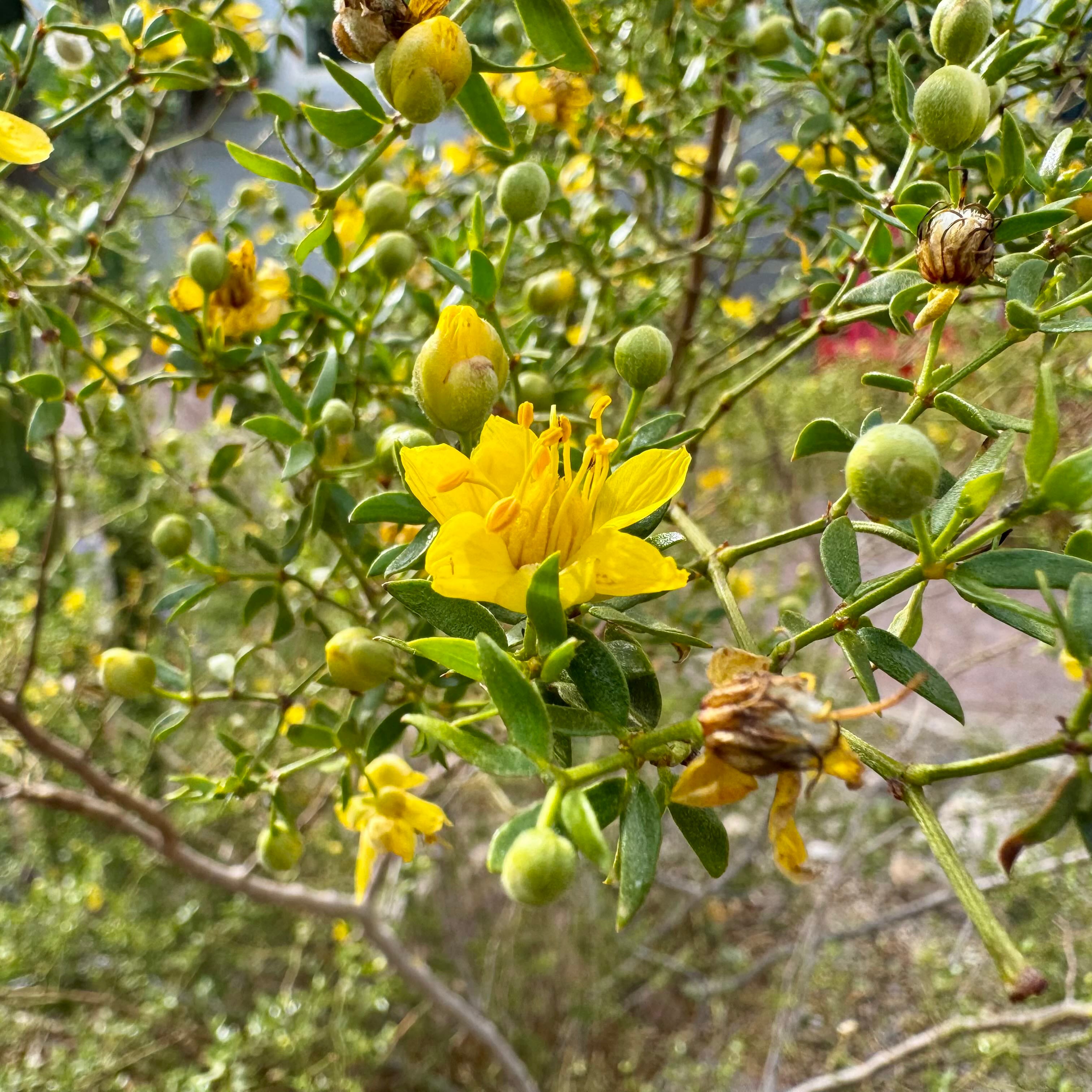
My husband is against my picturesque proclivities. Just this week, on a walk through the neighborhood, he referred to a large and stately creosote as a weed; I divorced him on the spot. Creosote are a desert jewel—they are blooming now and going to seed. The plants are covered in rich yellow, star-shaped flowers and round, glowing seed heads that shimmer in early morning light.
The Return to the Picturesque
Gardening in the United States and UK is in the midst of a picturesque resurgence. While the top-selling gardening books on Amazon are gardening primers and coffee table books filled with beautiful flowers, Douglas Tallamy, who advocates for wilder backyards, has two books in the top 50. The avant edge of garden writing is replete with invitations to use wilder, native plants in the home garden. There’s Shrouded in Light, Planting in a Post-wild World, Wild About Weeds, and Planting the Natural Garden, to name a few.
These titles suggest the picturesque is thriving. Even the backyard veggie gardeners, which have been beholden to university extension programs for the better part of a century, are thinking seriously about permaculture. We are rewilding our yards, a project that strikes me as particularly attuned to the picturesque.
History repeats itself, you know. But is today’s idea of the picturesque the same as the eighteenth century’s idea?
A Critique
Ross is not exactly on board with the picturesque. Drawing on the work of several critics, she suggests it arose from a particular anxiety about large-scale political and social changes in England, and a decline in good taste. (Sound familiar?) Critics of the picturesque, according to Ross, accused it of lacking moral responsibility and as emblematic of a crisis of confidence. They identified it as pessimistic, paternal and nostalgic.
Does the return to the picturesque reflect these same concerns? Or is the new picturesque different? Does it have a moral character that the old picturesque lacked?
Consider, for example, the current practice of leaving leaf litter in place. It’s picturesque through-and-through—very rough, very irregular. But there’s also the fact that it is better for my garden. It is a visual sensibility with material (and moral) consequences: decaying leaves feed my impoverished soil. The western banded gecko hides in leaf litter during the day to emerge at night and control the excess scorpion population.
Despite the ecological benefits of picturesque gardening, is there something darker, more troubling, in its resurgence? Does it signal that we have given up on the idea of institutions, that the grand theories for improving the world have failed? The return to the picturesque may suggest we have narrowed our focus in a way that excludes that larger world.
I say may because I do not know. While the wild garden is often articulated as revolutionary, as a site of resistance, I worry that this narrow focus on the backyard signifies a troubling turn away from the larger world. If the picturesque is a tactic that makes the world into something as small as a private backyard, what does it mean for the wider world of public and collective possibility?
A Defense
The picturesque invites us to cultivate wild and resilient plants, the result of which are more wild and resilient ecosystems. They may not be beautiful or sublime, but they are more approachable, more available to the average gardener. Which is to say: more available to you and me.
My sense is that today’s picturesque, as it relates to the garden, claims a stronger moral dimension than the old picturesque. Yes, for some an untidy garden may indeed suggest a crisis of confidence, a lapse in morality. I think a dying mimosa tree is picturesque, but there’s no doubt it provides fair cover for a certain laziness on my part.
But there is something plucky about the new picturesque. Despite the pessimism or crisis it may suggest, its attitude is at least moral, even though it may not be grand in the same way that Enlightenment institutions were. Rather, the new picturesque says, “I can make a difference in my small corner of the world.” It is a profoundly pessimistic moral orientation, but it may be the best option we have.