


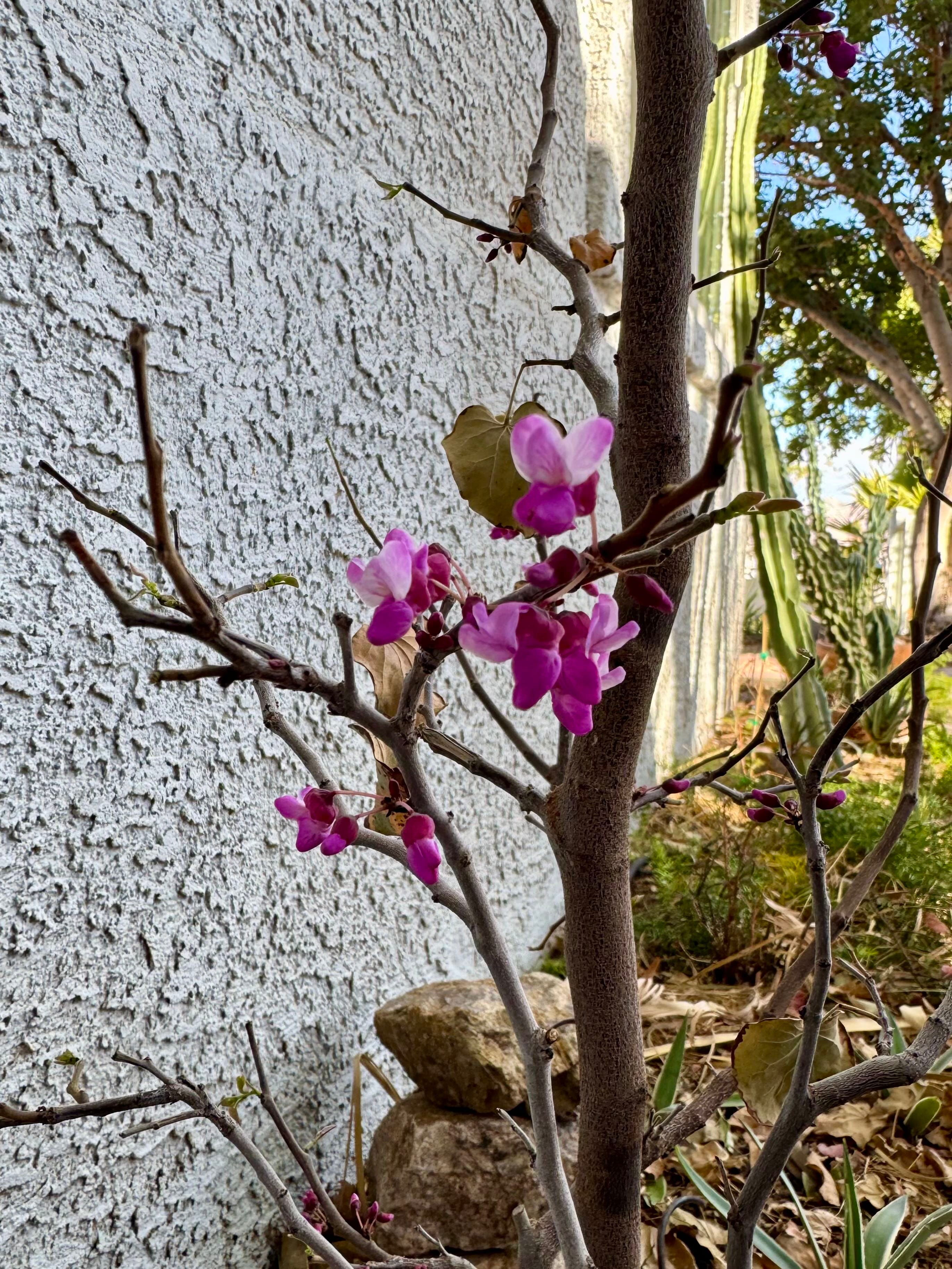
The delicate, pea flower-shaped blossoms of the redbud I planted last fall have opened. They grow from the sculptural trunk and branches, are a pale pink to deep fuchsia, and contrast especially well with the smooth, steel gray bark. There is little warmth to this tree, which is why I planted it on the northeastern patio. When temperatures soar in a few months, I want this part of the garden to feel deceptively cool.
Two redbuds for the desert garden
Redbud species in the garden are usually eastern (Cercis canadensis) or western (Cercis occidentalis). I planted a variety that comes from somewhere in the middle: a Texas redbud (Cercis canadensis var. texensis). Its leaves are crisped—a word that cuts itself short just before you would expect it to otherwise roll off your tongue. As a botanical term, it’s an excellent description for the leaf margins, which are wavy and rolling. In fact, the entire leaf looks like a giant clam shell. The leaves are also thicker than the common redbuds of Appalachia; their undersides are like felt.
These are smart adaptations for hotter, drier climates. The top of the leaf is not uniformly exposed to solar radiation because it rolls in such a way that only part of the leaf receives sunlight at any given time of day. The thick, felted leaves reduce evaporation. But to be sure, that doesn’t mean it will tolerate full sun in the low desert. Morning sun is best.
I also planted a Mexican redbud (Cercis canadensis var. mexicana) last fall. Its leaves are smaller, bluer, and rougher. It feels and looks in every way like a desert plant; more rugged, less graceful. More approachable, too. I purchased it from a backyard nursery in a half-filled gallon nursery pot: a burnt and pathetic twig hanging on somehow. I wasn’t sure if it would make it, but earlier this week I saw minute leaves, reddish-pink, then bright green, emerge like tiny folded valentines drawn from a secret envelope.
Sensitivity to the ordinary
I’m reading a new work on garden philosophy by father-son duo David and Ethan Fenner, The Art and Philosophy of the Garden. David is a professional philosopher and hobbyist gardener, while Ethan is a hobbyist thinker and professional gardener. Their central question, drawing on the nascent but growing work of garden theory, asks: Is the garden art? I have some thoughts, but I’m withholding judgment until I finish the text (I plan to eventually share a review).
Along the course of their discussion, they draw on the work of the American pragmatist and thinker John Dewey. Fenner Sr. is an aesthetics expert and his discussion of Dewey is clear and skillful. “The appreciation of art is based first and foremost on a particular sensitivity to the ordinary,” they say, drawing on Dewey.
I’ve not read Dewey in a very long time, and I have never read Art as Experience, but I agree with the Fenners that Dewey’s ideas about art and appreciating the ordinary apply to gardening.
Gardens prime us for the experience of art because they help us see the ordinary. They help us see the ordinary by arranging plants in novel and unique ways, and by training our attention to perceive what might otherwise go unnoticed. Gardens make all gardeners close readers. In other words, gardens force proximity to, and therefore awareness of, the ordinary.
Perhaps, as a gardener, you may not agree that plants are ordinary. You are wrong. They are so ordinary that many people do not see them at all! But you, gardener, can see them. All-too-well, actually. Which has transformed them into something less like nature and more like art. Their arrangement in your yard may even be a work of art.
You observe that plants are reaching, growing, moving, wandering (from here to there). Yerba mansa’s creeping stolons move with such speed and intention that it makes porous the plant-animal boundary; canna lily’s rhizomatic growth creates floral constellations out of a starchy, fleshy root; the sharp crack of the seedpods of Mexican bird-of-paradise signal growth on the other side of the garden. These are all ordinary achievements for Anemopsis californica, Canna indica, and Caesalpinia mexicana.
Gardening, whether art or not, has deepened my appreciation for seeing beauty of all kinds. It has been consequential for the development of my personal taste, both aesthetically and in terms of my taste buds. It has opened up a more expansive repertoire for experiencing, acknowledging, and describing the world.
Gardens and art
Gardeners are particularly suited to making sense of the ordinary. This fact alone may be why gardeners, and the philosopher-gardeners who write about gardens, are so keen to see their gardens as works of art. This isn’t vanity; rather, it’s sensitivity. Gardeners are particularly sensitive to seeing art in the ordinary, and thus in a garden. But this sensitivity may mean that only gardeners will ever think of gardens as works of art.
Still, I’m not sure I will end up agreeing that the garden is a work of art. For me, there seems to be something about a garden that precedes art. But I’ve much more reading to do—not just from the Fenners. There’s Cooper’s Philosophy of the Garden and Miller’s The Garden as an Art, as well as Ross’s What Gardens Mean. After many years of reading gardeners on gardening, I’m thrilled to dive into a fresh and growing body of literature by philosophers on gardening.
I adore redbuds and the 2 species you mention seem to be the best for our region, although in my experience, really hard to find (it's possible there are sources I don't know about). They are among my favorite trees, not just for the spring flowers which are of course incredibly beautiful, but I love the leaves. You're so lucky to have the eastern exposure to be able to enjoy a redbud in the Vegas Valley.
My gal Mary Irish says the Cercis var. mexicana is more shrubby than var. texensis and as you know more drought tolerant, but still needs regular irrigation in summer.
And I agree that gardening over time acutely sharpens our vision. If one does not really "see" plants it's hard to recognize their value, or even notice when something is badly pruned (not very philosophical but your post has given me new perspectives to think about!).
Thank you for a beautifully-written post!
Your perspective on the philosophy of gardens is a topic I've often discussed without realizing how much has been written about it.... I just purchased What Gardens Mean by Stephanie Miller—thanks for sharing these titles! I'll be working my way through the others as well.