


The desert garden is particularly prone to failure. Or so I tell myself, as I slink in the shadows of the valley of death: the hot summer garden. Of course, many of the plants only look dead.
The natives have gone dormant, the penstemons (Penstemon spp.) receding to a few basal leaves, the spiny senna (Senna armata) revealing a leafless labyrinth of thin green branches. Although the recent moisture and cooler temps have forced a few minuscule leaflets.
Must gardens be beautiful? Is my garden beautiful? What does it say about me? I read once that the English cleric Thomas Fuller said, “As is the gardener, so is the garden.”
But gardening well and being a well-adjusted gardener are two different skills. Thinking of gardening as another way of seeing, perhaps as close seeing (the horticultural equivalent of literary criticism’s close reading), helps.
The snag I’ve kept in the back yard, and which has accrued dissonance to my marriage in inverse proportion to its demise, is a failure. I refused the interventions it likely deserved; it has succumbed to heat and disease. But it reminds me that death is not one-dimensional.
In the evening, two hummingbirds chase each other into the sky, a vortex of libidinal energies, before landing apart on the snag’s lofty branches. There, the little lords admire their diminutive kingdom, which must seem mysterious and grand when viewed through the twiggy scaffolding of my dying mimosa (Albizia julibrissin).
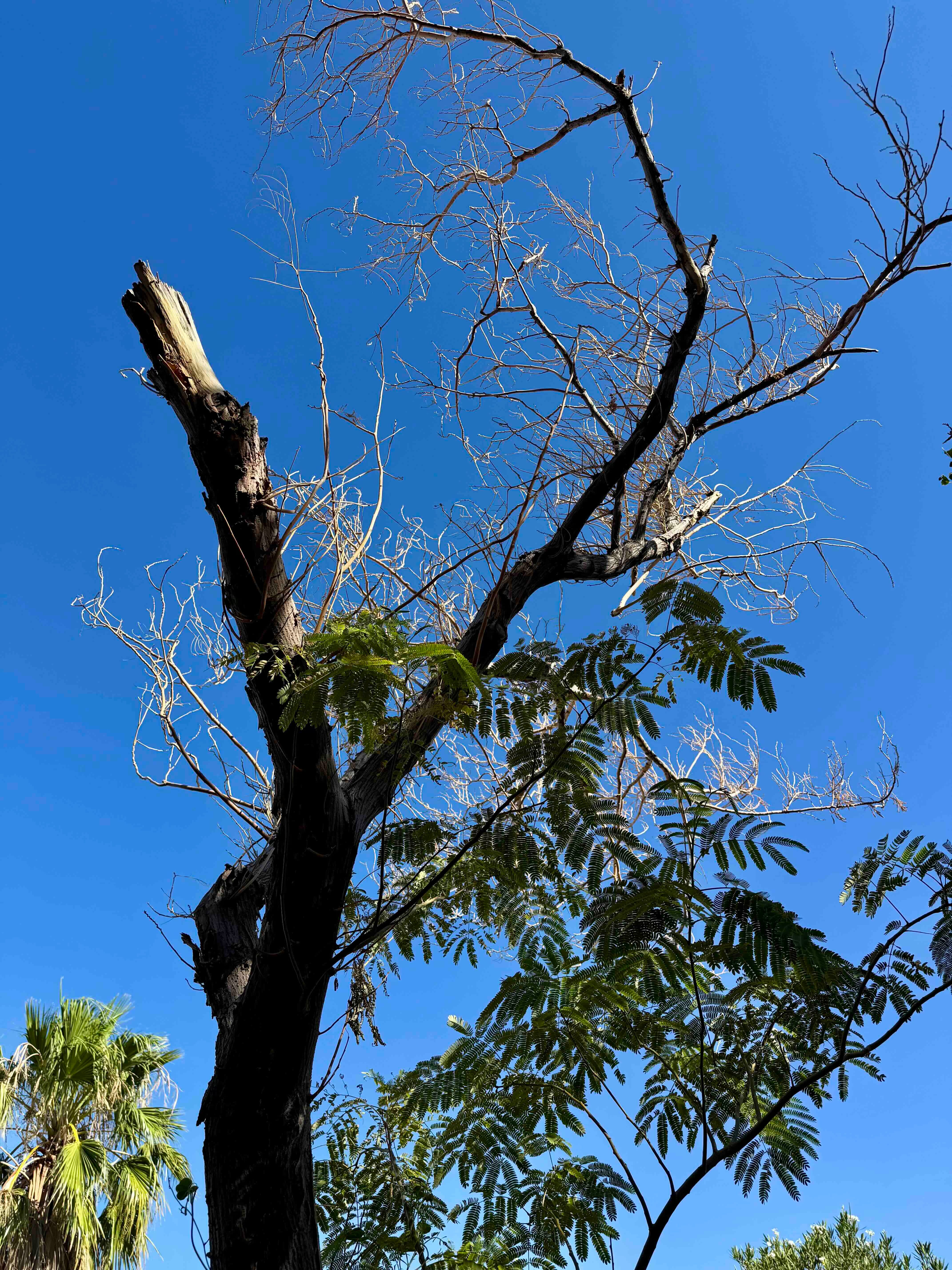
In forests, snags occupy important ecological niches. As they die, they shelter insects, fungi, birds, and mammals. In a park near the house I grew up in, the local raptor society identifies snags in the park’s wilder areas and asks the superintendent to keep them around. Not all of the park's visitors appreciate these dying trees, but it seems like a small sacrifice to give Cooper’s hawks or American kestrels improved habitat.
Of course, my garden is not a large urban park; its ecology is an impoverished resonance of the great ponderosa forest from which I took the photo below.


But when I think to remove the decaying tree in my back garden, carpenter bees soon remind me that it is good lodging. They flatten their bodies until they look like glistening oil slicks seeping in reverse. During certain times of year, I hear their busy mandibles burrowing deeper into the aging trunk.
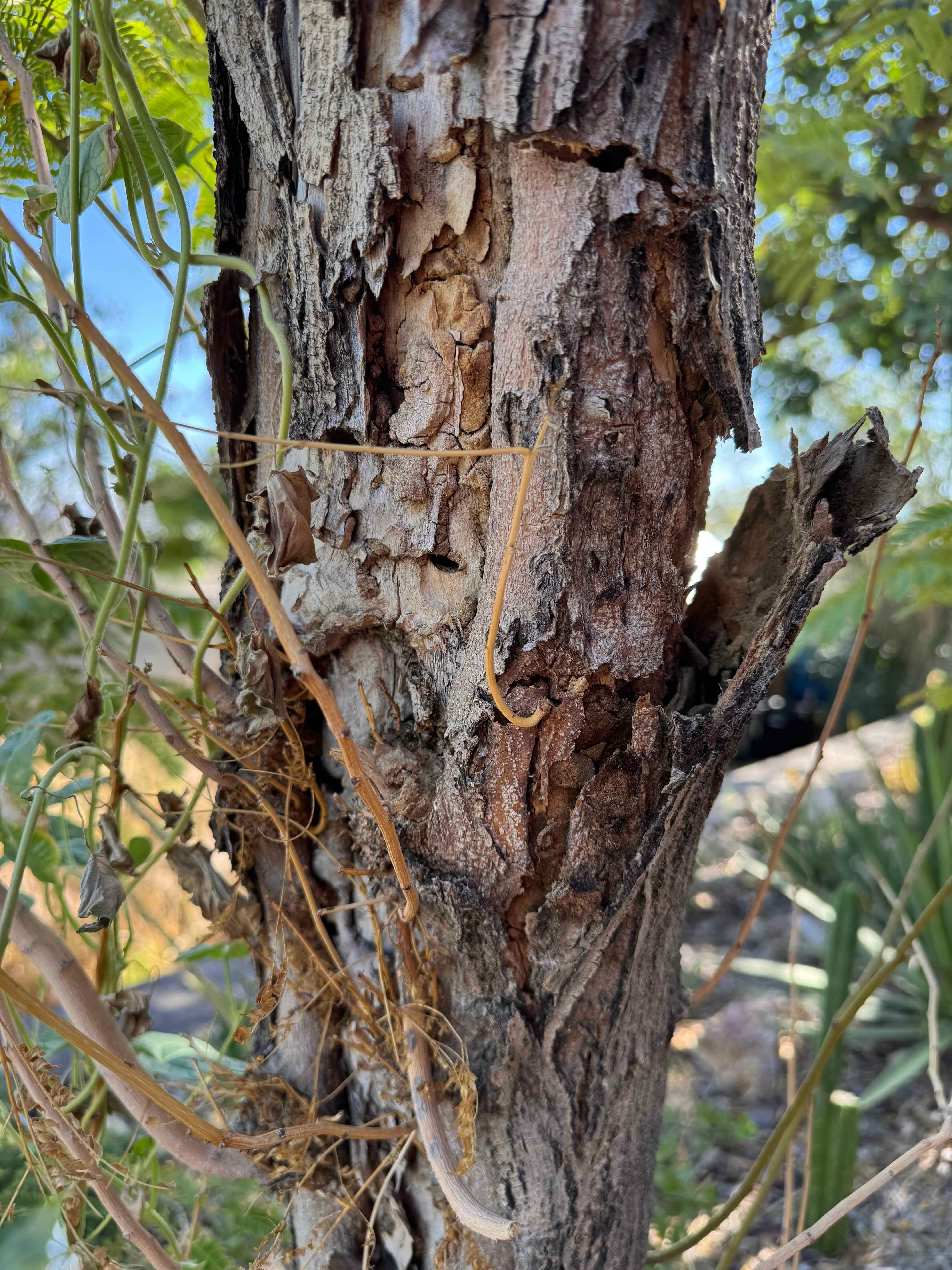
I should take it down. Remove its unsightly presence from the garden. Spare me the marital stress, the ersatz interest of well-meaning relatives, the daily reminder of my failure, this tree’s failure to thrive under my watch. Spare me the questions about what it says about me, about my bad practices. (What would the Zen gardener Muso Soseki think, who said, “He who distinguishes between the garden and the practice cannot be said to have found the true Way.” Can a garden out of practice still be true?)
But the tree is not dead, only dying. Its delicate fronds, photosynthesizing waterspouts, stretch beyond its trunk and shield the agaves and Portulucaria and cactuses growing beneath it. A morning glory vine, burnt from the sun and insufficient water, twines slowly around the brittle, sloughing wood.
I’ll plant more vines, give this snag multiple duties: ecological and horticultural. Turn it into scaffold, a vertical nursery for growing plants and animals, for seeing the garden a little differently.
Snags are so misunderstood (I have a dying redbud in my backyard right now). As gardeners, we often feel that if everything isn’t perfectly tidy or vibrantly green, we’ve somehow failed. But there’s immense wisdom in witnessing decay unfold and appreciating all the life that thrives through that process.