


There are signs of spring. The flowering stalks of aloe are starting to emerge; they look like asparagus tips, inching up between fleshy leaves. The stems on the brittlebush plants are rising above the foliage. The kumquats are almost ready to eat. The desert forsythias are bursting into bloom.
I made that last one up. I like it as a new common name for the Australian sennas that are pedestrian in the desert southwest. I grow two of them: Senna nemophilia and Senna artemisiodes. The former has bright green, very narrow leaves (phyllodes, actually). The latter comes in various cultivars, but the leaves on mine are feathery, the color a bluish green.
Widely known as cassias (and they used to be in the cassia genus) they are scientifically identified as sennas, which puts them in the same genus as our southwestern native sennas, including Senna armata, which, in my garden, grows near its Aussie cousins. It will bloom later this spring and into summer. Sennas are legumes. They have the amazing ability to take nitrogen from the air and put it into the ground, where they use it to make even the most inhospitable soils a little more fertile.
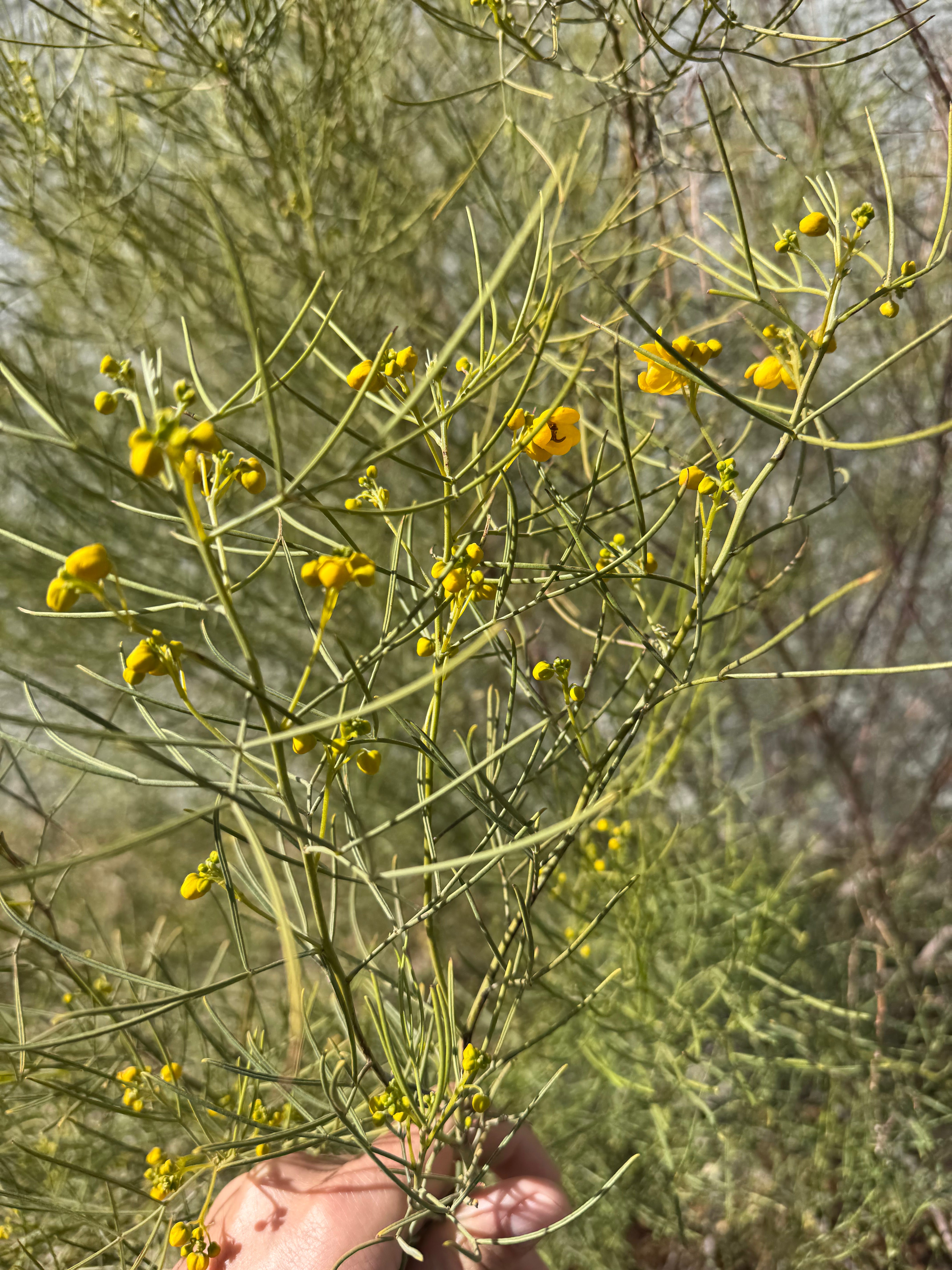
Forsythia reimagined
The forsythia you are likely most familiar with, Forsythia x intermedia, is native to eastern Asia—it looks nothing at all like the desert forsythia that grow in my garden.
The advice for east Asian forsythia is to plant it in the back of a border, or at least some place where the plain leaves and unassuming architectural features can fade into the background. It is prized by most gardeners for heralding spring with bright, acid yellow flowers. Indeed, flowering forsythia, along with the earliest daffodils, still means spring to me.
I once experienced forsythia twice in a year. Once, in my old garden in spring in Salt Lake City, and then again that same year, outside of Boston, when our son was born. On the eastern seaboard, forsythia blooms about a month later than the high deserts of Utah. We were staying in an extended stay type hotel while we waited for adoption paperwork to clear. There were fields of forsythia everywhere, growing wild and reckless. Forsythia is forever tied to my son’s birthday, even though the association remains true only in the backwoods of Massachusetts.
Desert forsythia doesn’t exist. But there’s no reason it couldn’t. Common names are taxonomies of place, they are discrete and not at all generalizable. Accessible to you and me in the moment and place of our existence. I think this makes them also more useful.
I can imagine a new arrival to the desert strolling the aisles of a nursery, totally bewildered about what to plant here, and seeing a name like desert forsythia. Forsythia would trigger in her mind the idea of bright yellow blooms heralding the arrival spring. She’d know immediately how it might be incorporated into a garden that is trying to achieve a certain rhythm of bloom and color. Desert would tell her something about its adaptations. All the Australian sennas could be grouped into this category, and she could choose from a leaf pallet that is diverse in form and color, picking perhaps S. artemisiodes for areas that call for a cool color scheme, and S. nemophilia for a bright, limy green contrast against a stucco wall.
Gardens as ritual
I’m reminded of the Diné medicine man, Betonie, in Leslie Marmon Silko’s Ceremony. He’s able to help heal the main character, Tayo, who lives with post-traumatic stress disorder, only because he’s willing to try new ways, to adjust the ceremonies for a different time.
“Don’t be so quick to call something good or bad,” Betonie says, during a healing ceremony for Tayo. “It is a matter of transitions, you see; the changing, the becoming must be cared for closely. You would do as much for the seedlings as they become plants in the field.” He provides this important context for Tayo because Betonie does not stick to the ceremonies in their traditional sense. He has made changes. Those changes have resulted in his ostracism, but also in his success as a healer.
“The people nowadays have an idea about ceremonies. They think the ceremonies must be performed exactly as they have always been done, maybe because one slip-up or mistake and the whole ceremony must be stopped… [But], in many ways, the ceremonies have always been changing…Things which don’t shift and grow are dead things.”
There is an idea that scientific order (botany, in fact) can bring clarity to gardening, making it truer and more perfect. The same idea pervades the ethos of design, as if the arranging of plants in a particular order—their vibration, as the great British garden designer Russell Page, might have said—predict a certain degree of success. And it is true that a scientifically managed garden will yield particular results, higher productivity, for example. A well designed garden does something similar, yielding a certain kind of harmony, a symphonic cadence of blooms.
But a garden is something deeper. It is a kind of ceremony, with patterns, symbols, languages, lives, and manners. A garden, even the loneliest, saddest pile of rubble and weeds, can only ever be true so long as it is gardened—so long as a hand tends to it.
Gardening understood this way (as a phenomenological interaction with non-human life), means that it is wildly open to revision, which is to say it is especially amenable to change. Not just in substance (the kind of plants we use), but also in symbol (the way we talk about our gardens, or the names we give them, both their parts and as a whole).
Naming the desert garden
I like using common names and even think we should come up with new ones. It is true that a scientific approach to gardening (whether it is called botany, agriculture, aesthetics, or horticulture) is necessary for certain gardening inputs (for example, getting the precise seed you want), but gardening is not these academic disciplines, though they may be useful for studying gardens. Instead, I understand gardening as a modality, a way of interacting with the non-human world that acknowledges that the interaction changes that world and is changed by that world. Another, and perhaps more concise way of saying this, is that gardening comes before science and art, it collapses the subject-object distinction of enlightenment thinking and is instead a totally distinct way of being in the world.
That may seem like a lot to put on digging in the dirt and throwing in a handful of seeds. But gardening is the primordial act, superseding all that has come after. The fate of our human structures, the things that came after the first garden, depend on us going back in a meaningful way, before science and art, before the invention of horticulture, to that way of being in the world.
While that idea may seem very heavy, there’s also a playfulness to it. I imagine the conversations Eve and Adam must have had as they wandered the garden, coming up with names for all of the delightful and sensuous things they saw. I imagine how those names changed the quality of what they saw, for better and for worse, and how those names then changed them, and their progeny, and all of us.
Cultivating the vernacular
I try to always use Latin names in my writing because it provides a common language for other scientific-minded gardeners. But it does almost nothing for most of my readers, who do not interact with their gardens in this overly precise way. Instead, we could come up with more sensible names, more place-driven names, that adhere to the very specific space- and time-bound conditions of gardening.
Desert forsythia may be a silly example—but I like the sound of it. I like how it tells me something of place (arid, dry) of color (acid yellow) of placement (near the back) and timing (late winter or early spring). These are all very useful for the gardener, independent of (and perhaps in addition to) native status or binomial nomenclature.
As the earth finally tilts toward the sun, I plan to wander my own garden, far from paradisiacal it may be, and name what I see. Some names will be useful and meaningful only for me, and those I will keep for myself. But others I will gladly share, if I think it may help you in your own gardening efforts. In doing so, I will remind myself that the ceremonies don’t have to be performed the same way. As my garden shifts and grows, the symbolic structures I attach to it will shift and grow, too—that’s what makes a garden alive.
Gardening is an interesting world where the scientific and vernacular coexist and overlap and the names given by each are useful for different things. I love language and (other peoples’) beautiful gardens. I don’t personally grow anything but weeds and whatever the squirrels plant (mostly walnut trees in inconvenient places), but my mother has always been a gardener. Even in her condo, her front walk is lined with gorgeous flowers. Her parents gardened, too: my grandmother carefully planned flower beds and my grandfather inserted random tomato plants among them :D
I love this one. It feels very appropriate for this time of year, very thought provoking. It reminds me of how I’ve been staring at the outside world through the window, wondering if the green world will ever wake up again and what I want to name my flowers.