


Succulent stems stretching across parched ground, watery leaves folding up, then down, was the third weed thing: purslane, pigweed, Portulaca oleracea.
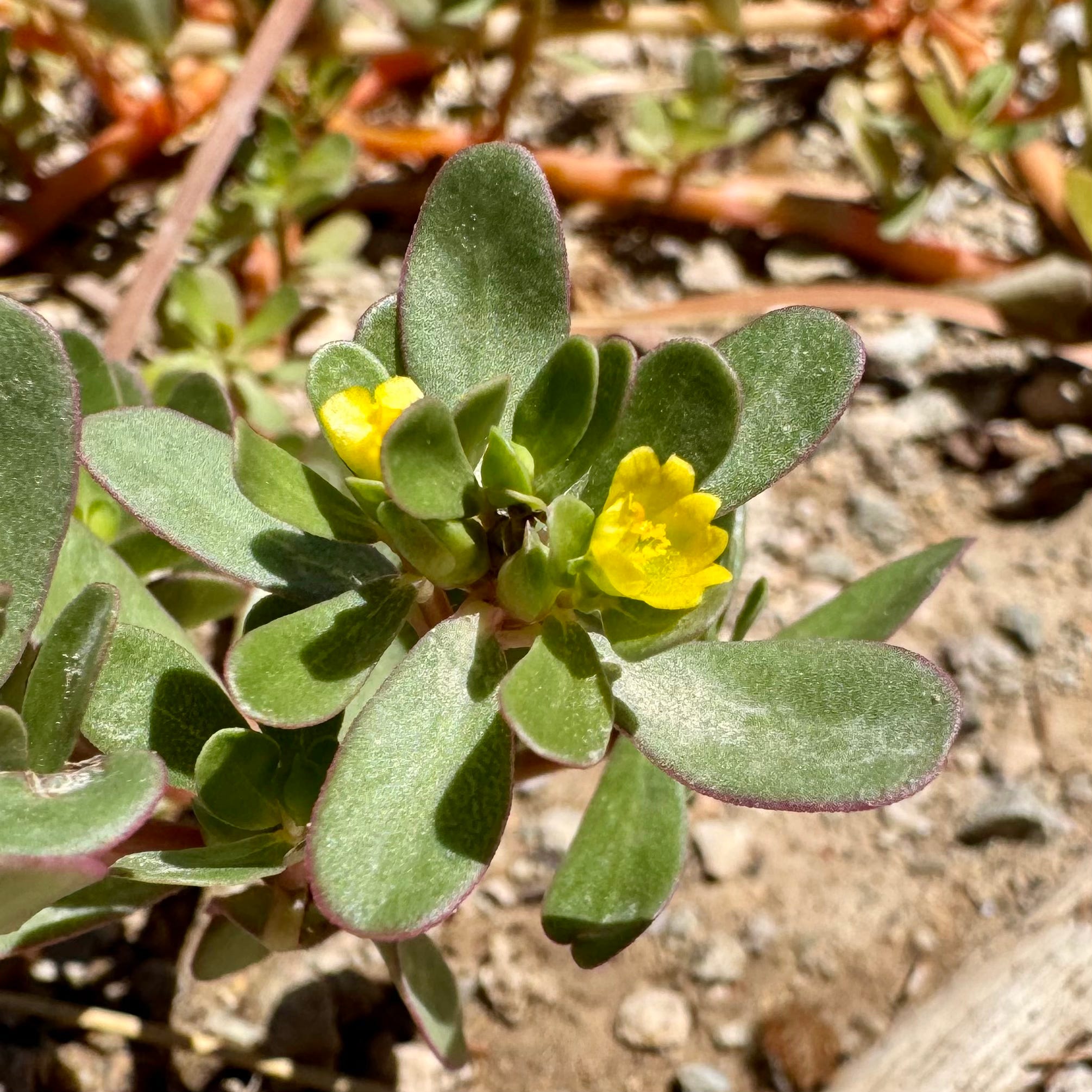
Things in three, you see. Three plants, three groups of three plants. This is what counts as design for me, who gardens from the spleen. I am a mess of intuitions as I gaze about the garden, hoping to identify some secret emanation. The garden designer Russell Page said, “Every object emanates—sends out vibrations.” Pay attention.
I’m paying attention to weeds.
The first weed thing was a book, Wild About Weeds, by Jack Wallington, a darling of trendy British horticulture. My sister checked it out from her library, and we thumbed through it when I was in Salt Lake City to visit family a few weeks ago. The weeds were all from wetter places, and I thought that many of them were hardly weeds at all. Rich greens, yellow and purple flowers, and rampant growth! I would sow them all in my Mojave garden, if they would but grow.
The second weed thing: a memoir, by Marco Wilkinson, told through weeds. He and I share a birthday. Like Wallington’s book, it includes weeds of wetter, abundant places. While reading in early morning light, beside a recently cut field of alfalfa on the Utah-Idaho border, I learned that some weeds smell best fresh (mint, for example), while others come into their own when dried. Hay is in the latter group, and the compound responsible for that morning’s sweetly rotten scent is coumarin: the smell of fresh-cut hay.
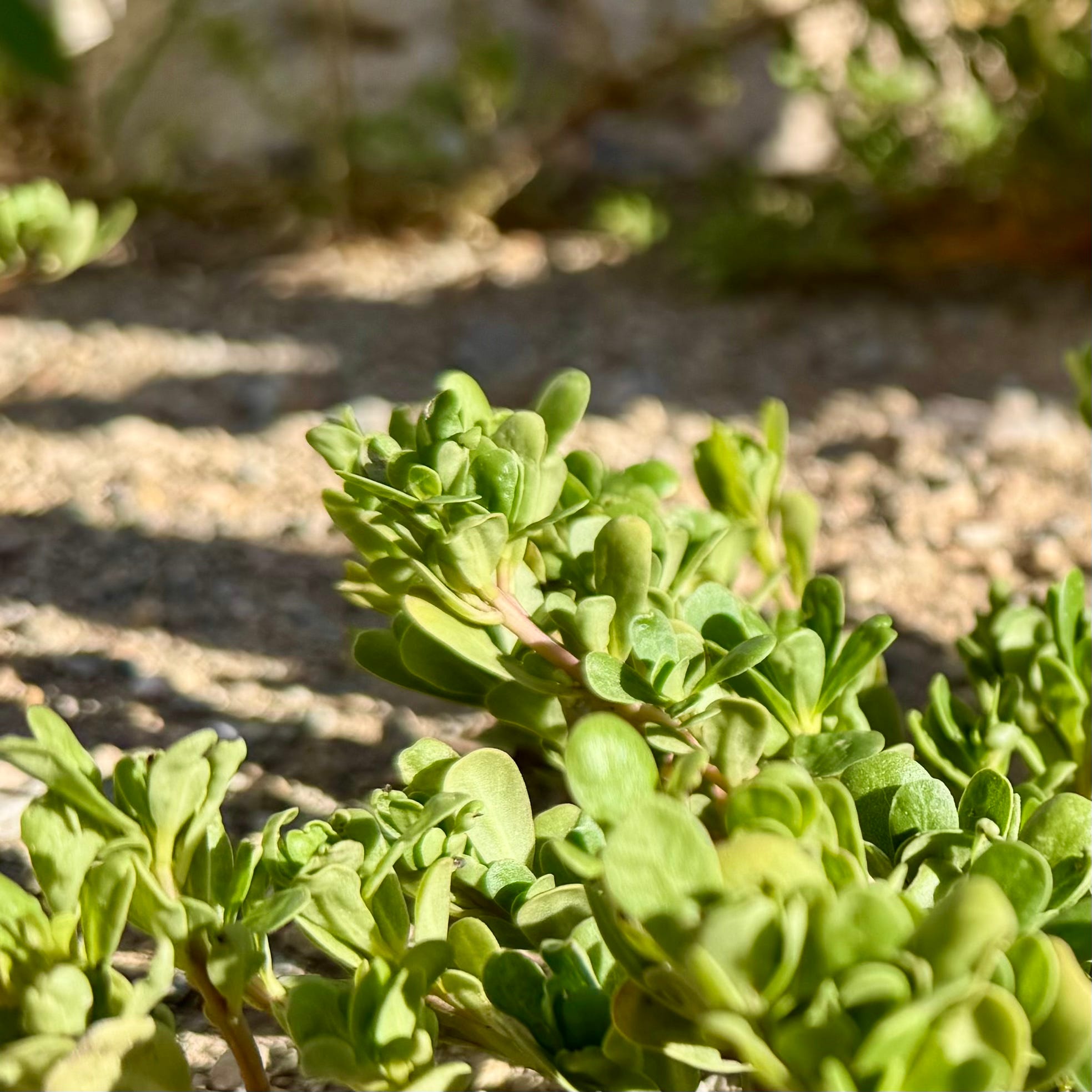
I was taught that a weed is just a plant growing in the wrong place. But a weed in the Mojave seems like an impossibility. Here, any plant that grows is in the right place.
Some call creosote a weed. They say it desertifies: that is, makes a desert. As if the desert were an error, all along the creosote’s fault. If we could but root it out (also: desert broom, white bursage, Mojave yucca, and beaver tail), the water would somehow return.
This myth, that agriculture brings with it rain, persisted for decades, fuel for Manifest Destiny. We filled the west with the quixotic idea that, if we but planted, the rains would come. The phrase was quaint and perfect, the kind of motto I wish we had now (if only it were true): rain follows the plow.
Like all perpetual motion machines, it was of dubious origin. Rain does not follow the plow any more than Larrea tridentata causes drought. Creosote makes fertile islands, little nurseries in the dry Mojave sea.
But before we could plant, we had to clear out the weeds and bring in new ones. Purslane is one of them.
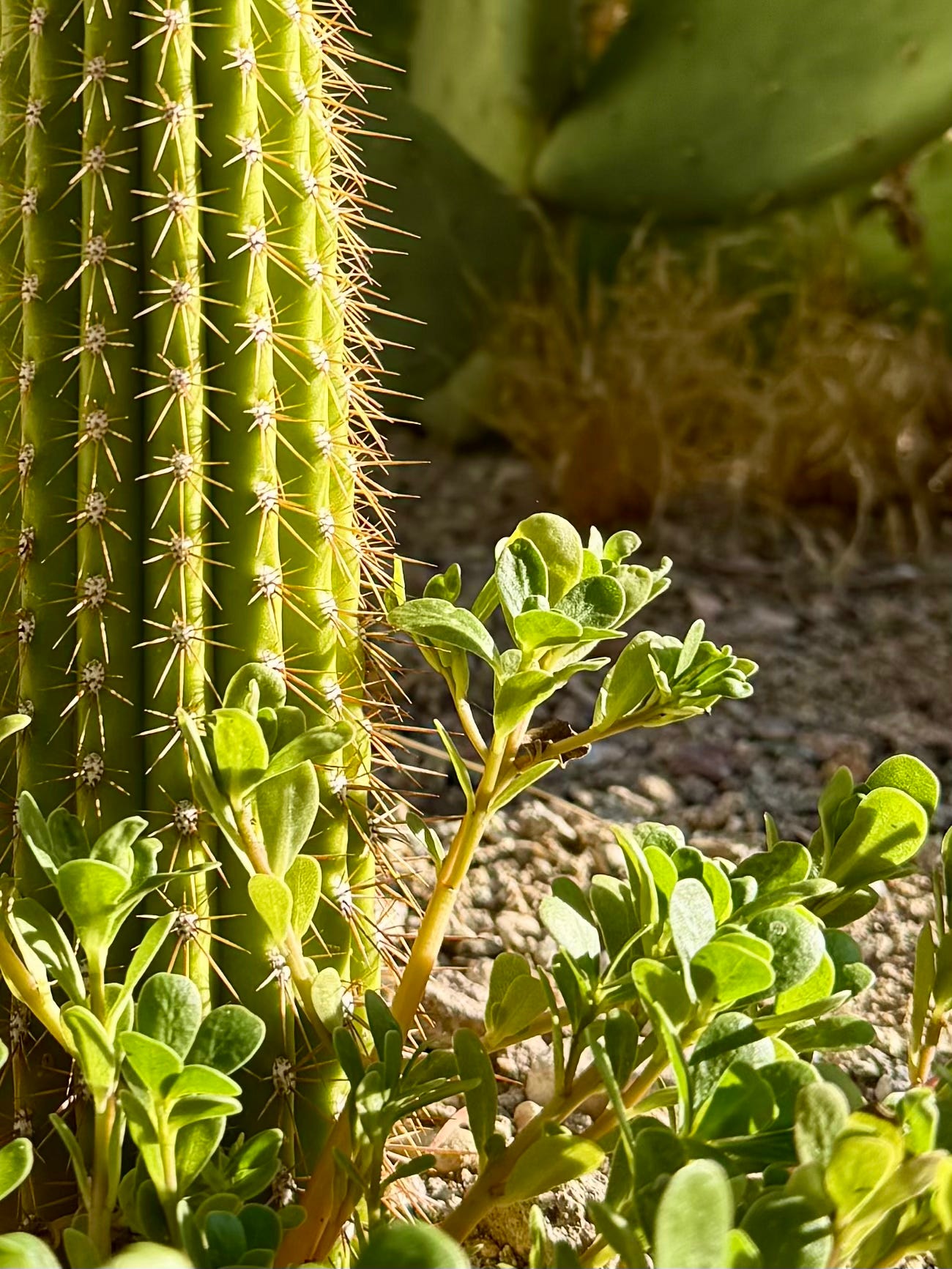
To be clear, purslane is not exactly xeric. In my garden, it grows among newly placed plants, often those planted last fall or, if I was anxious or delirious, in the spring. For example, my best crop of purslane is next to the golden torch cactus cuttings I added to the garden a few months ago. These currently get more water than they normally would as they adjust to the garden. Purslane also grows well near the muhly grass (Muhlenbergia capillaris) that was planted late last year and gets some extra water while they establish. But purslane needs much less water than spinach, the taste of which it mostly closely resembles, and does not bolt.
Purslane is of unknown origin. It has been cultivated for so long that it shows up wherever humans are: a plant without a past. Strangely American, even if we rarely see this vegetable in our wraps or on our salads in the United States. It is more common in the Mediterranean.
Certainly, you have purslane in your garden. Pick a stem. Put it in your mouth. It tastes good.
It also shades the ground, shields the cactus from the gravel’s reflected heat. It has tiny buttercup flowers, and the leaves are quasi-animate. They fold up in the day, and lie flat at night. Like a moth. It could take flight; over the long summer, it does. Purslane flies, just too slowly to see.
This year, I started gardening with 3 raised beds and planted an artichoke and 2 types of lavender plants. It didn't take long for weeds to show up and purslane. I thought purslane was an interesting succulent type with its yellow flowers but ruled it as a weed and dug it up. Now, I'm reading, as well as your article states, it is a delicious edible plant. Amazing! Thanks for your article about weeds and other foliage in the desert.
Isaac, I love purslane too! Such a delicious and crunchy little succulent. I've grown both the green and the golden versions from seed, but it still comes up anyway on its own in my garden as a treasure whether I plant it or not. It's so wonderful with the lightest sprinkle of a really good quality walnut or hazelnut oil and coarse salt. I'm looking forward to seeing it in my garden again this year! ❤️