


If the desert were a color, it would almost certainly be yellow: creosote’s tiny, star-shaped inflorescences; the clear, bright yellow of desert marigold; brittlebush’s graceful, nodding, saturated petals; sulphur-yellow lichens on orange granite boulders; ground cherry’s buttercream parasols.
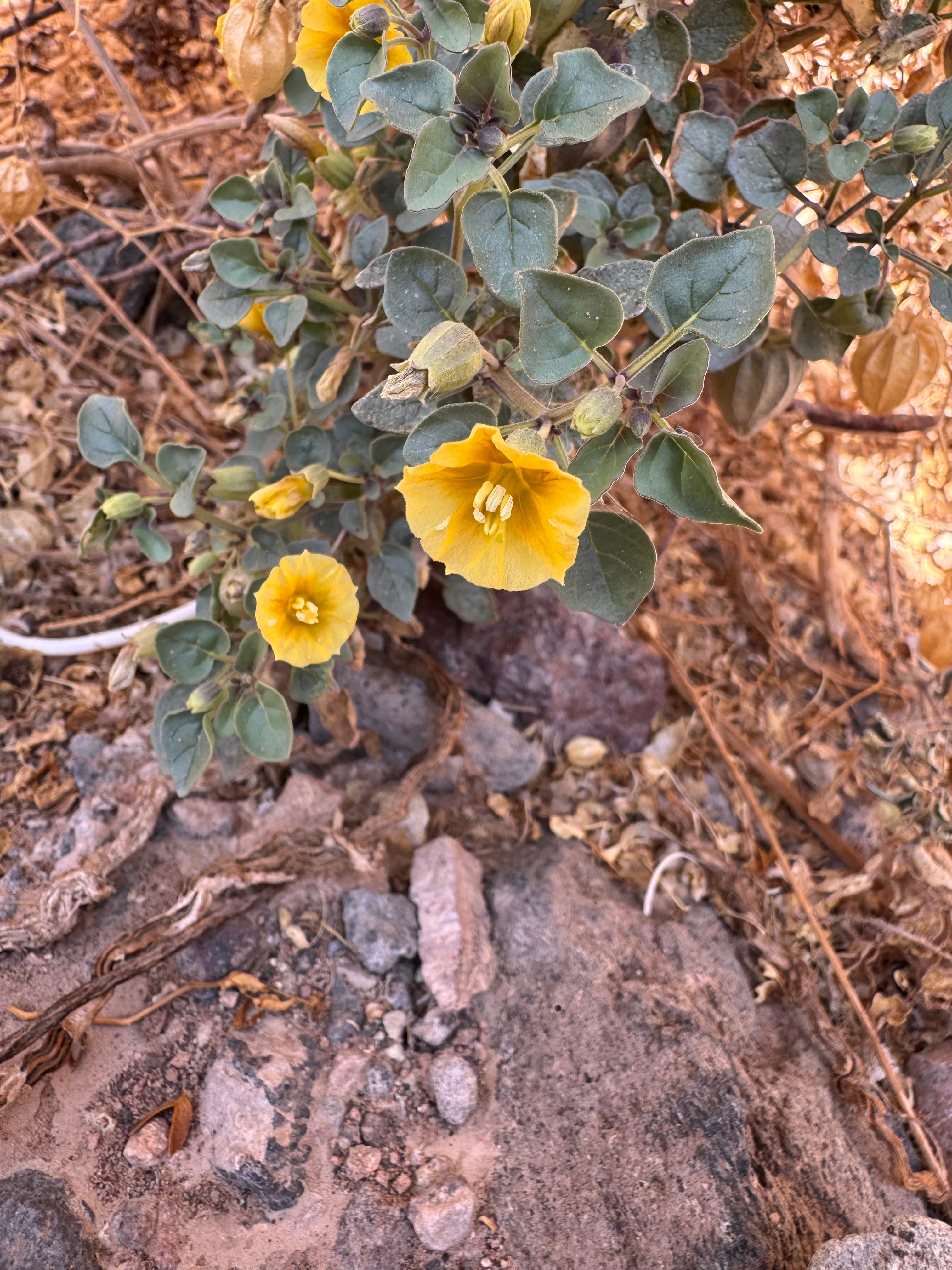
But blue must be a close second; February, its favorite month. Try to hold it in your heart, this month, this color.
The first spring flower, which opened in the warmest, sunniest part of my garden, was blue. The desert bluebell (Phacelia campanularia) is all the more alluring because the stamens are a very pale yellow, almost white.
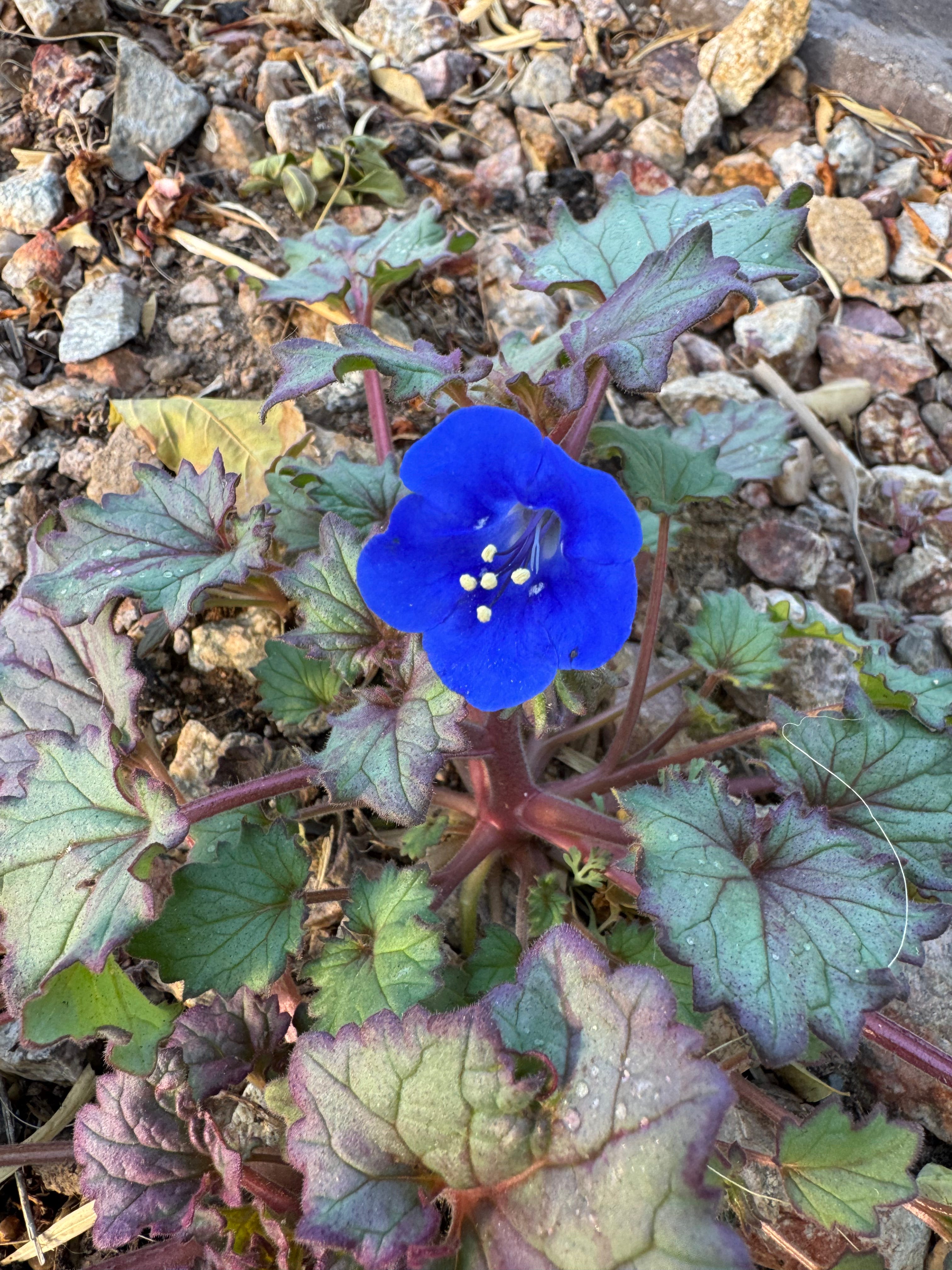
The possibilities for blue are rarely as rich as this, though. The powder blue of brittlebush leaves is much more common. They will be blue until they turn white with drought.
Both of these blues—rich and pale—are the February sky; it sways between them, its qualities changing in tandem with the quantity of atmospheric moisture. This year, it has not been much.
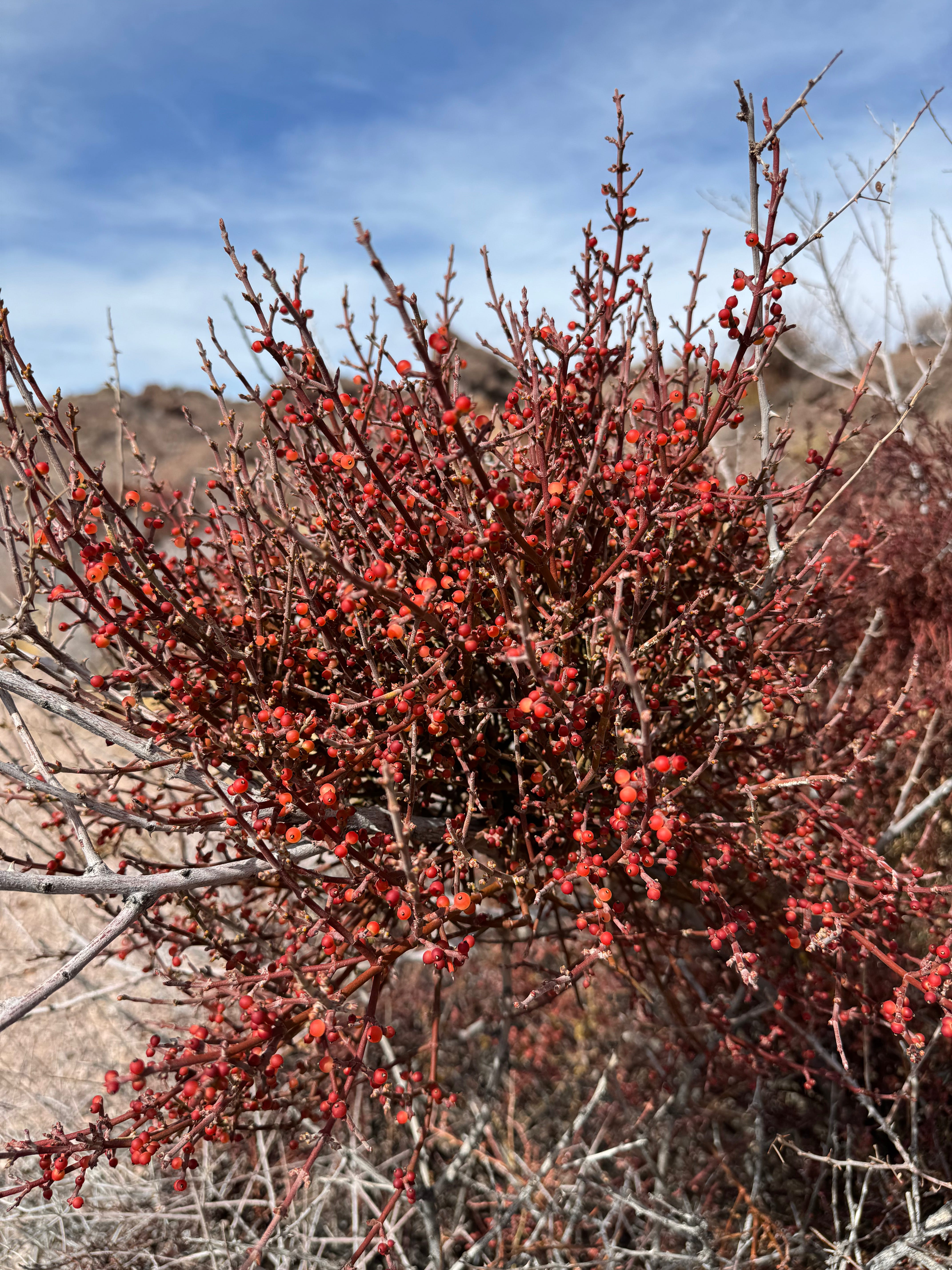
On a desert hike this weekend, the sky was the beginning and end of blue’s narrow place in the color spectrum. Red and yellow rocks served as perfect, primary foils. But the red-orange berries of desert mistletoe (Phoradendron californicum), which have parasitized most of the catclaw acacia (Senegalia greggii) in Oak Creek Canyon, just outside Nelson, are best in this matter. When I saw them, they were rich, ripe, and full of water. Their backdrop was a thin sky, as if it were veiling itself, ashamed of the depth of its blue.
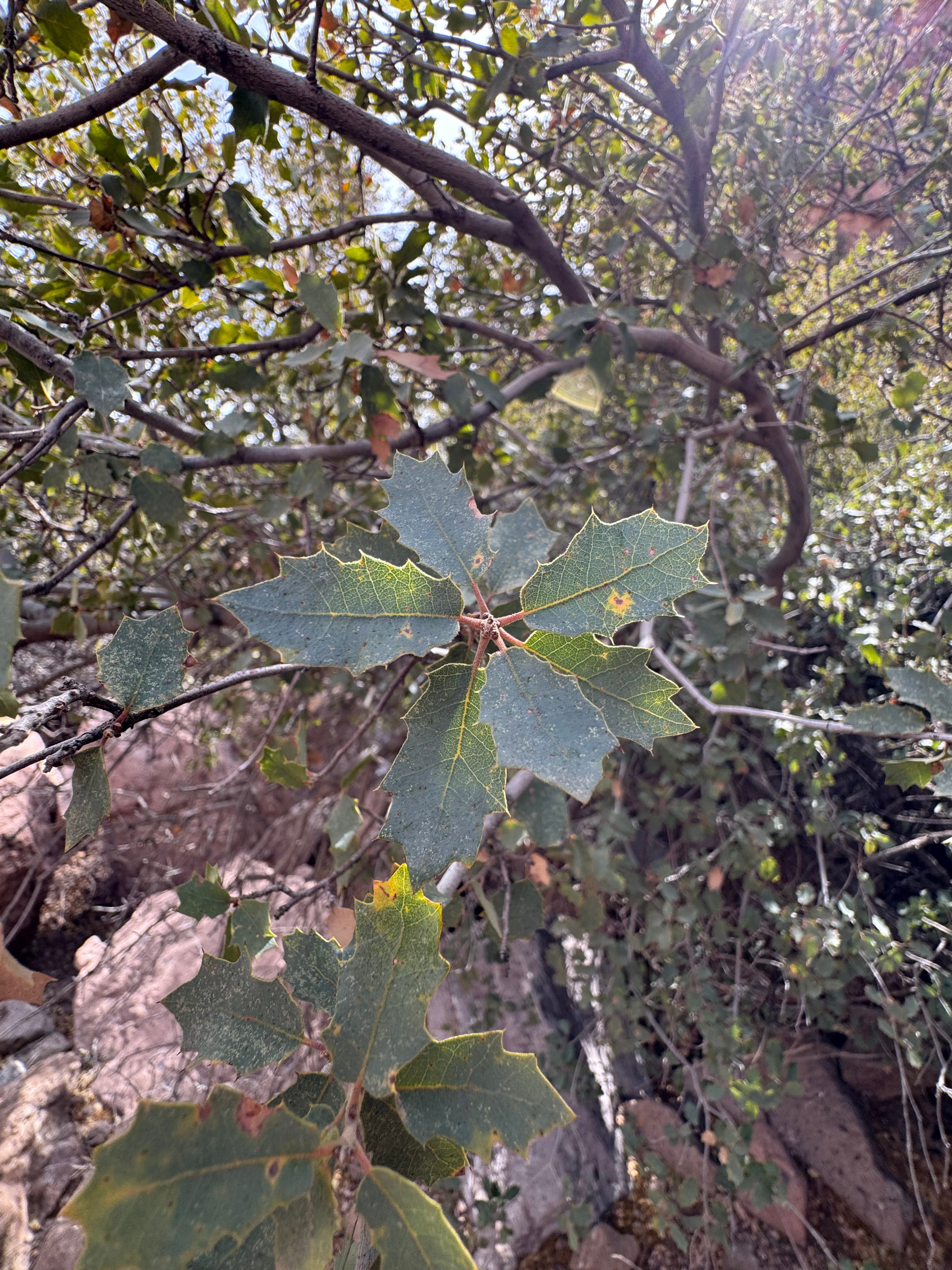
As I walked deeper into the wash, the shrub oak took hold. Quercus turbinella is the gnarled, unruly ruler of the small riparian forest in the heart of this wash. Its leaves are thin, leathery, and blue.
Blue flowers are rare. They so often veer toward purple. But blue flowers are probably more common than green ones. The only one I know of is silver cholla (Cylindropuntia echinocarpa). A neighbor grows one in her front garden. In mid-to-late April, blue and yellow conspire to make a green that I cannot pull my gaze from. I wish I could say with some certainty just how green they are, but you have to see them for yourselves. A photo won’t do.
Blue Flowers
While blue flowers are rare, many grow well here. As I’ve mentioned, there is nothing quite like desert blue bells (Phacelia campanularia). They are sneaky annuals, appearing all over, sometimes in thick blankets around irrigated shrubs and perennials. This can make them a nuisance for some people, but anything that grows carefree and blue is welcome in my garden. Grow these by seed, broadcasting them fall through winter.
Another carefree, if all-too-common, blue-flowered plant is rosemary (Salvia rosmarinus). Its pale blue flowers start in late winter and continue into early spring. This is an easy plant, and there are many cultivars to choose from, the blues more or less saturated depending on the variety. They come in upright and prostrate forms. Too frequently, rosemary is sheared into the weirdest shapes, stripping it of the natural, rugged form that looks so at home here in the desert. Prostrate varieties are beautiful overhanging a retaining wall. The leaves, when crushed or brushed by your hand, are immediately cheering. There are few better remedies for the winter doldrums than deeply inhaling rosemary.
Several indigo bushes are native to our region. While their flowers may be more indigo than blue, I cannot tell the difference. I grow two: Psorothamnus schottii and Psorothamnus arborescens. They are both new to my garden. Regionally native plants have been difficult to source here, but it is getting easier, thanks to the pioneers behind Mojave Bloom. Many of these natives are shrubs.
Shrubs are the backbone of a garden. In the desert, I’m becoming more sympathetic to the idea that they are the garden. A fine and strange book is to blame for my change of heart. But desert shrubs are easier to grow than perennials, require almost no care and very little water, and, unlike most of the evergreen imports in many of our gardens, actually change with the seasons.
Blue Foliage
While blue flowers are rare, blue plants are common in the desert, usually in the form of glaucous leaves. Glaucous leaves are a desert adaptation that help plants retain moisture during hot, dry summers. Brittlebush (Encelia farinosa) is among my favorites. It grows with zero input, is easy to find, and readily reseeds, lending itself to naturalistic gardens.
There are many blue-leafed agaves, but scabra (Agave scabra) is the easiest to find and grow in southern Nevada. It is rare among agaves; it can take the desert’s full sun and even the reflected heat of a dry, gravel garden. Scabras are not so blue or graceful as Agave americana or some of the Agave parryi varieties, but they make up for it in their toughness.
Lastly, consider purple prickly pear (Opuntia macrocentra). The pads develop a purplish tint in the winter, but for most of the year, they are baby blue. There are several cultivars and a lot of variation in the species, some turning dark purple in the cold. In others, the new pads are deep maroon. The causes of variation may be environmental (they all grow a little differently depending on where they are in my garden). Purple prickly pear is sometimes confused with Opuntia santa-rita, which I find much more purple (and often covered in scale). Opuntia macrocentra appears resistant to cochineal scale. But they may each be variations of the same species.